|
 |
 |
 |
 |
 |
 |
 |
 |

 |
NATO's Afghan Caveats Harmful
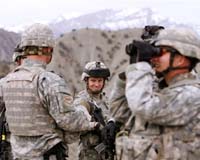
UPI Pentagon Correspondent Washington (UPI) Nov 22, 2006 NATO members have come through with only 85 percent of the troops and capabilities to which they've committed, and some of the 36 countries who contribute a total of 33,000 troops to ISAF have also placed caveats limiting their use to peaceful missions, top U.S. military and diplomatic officials said Tuesday. Germany is of particular concern, said Amb. Daniel Fried, Secretary of State for European and Eurasion Affairs, at a breakfast with reporters Tuesday. "Four allies are doing a disproportionate share of the fighting," Fried said. "Germany is still working the issues of what it means to be a leader in the world," Fried said. "I am not criticizing allies like Germany, which has a large and effective (provinciual reconstruction team) in the north. But caveats are not what we like to see in NATO operations," Fried said. Exactly which nations have exactly what caveats is politically sensitive and the information was not immediately available, a State Department spokesman said. Germany has 2,700 troops in Konduz, a relatively safe area in northern Afghanistan. They are limited by Germany's parliament to working with the PRT; they can not be moved to respond to contingencies. The country is still grappling with its role in World War II and the appropriate role for its military against that aggressive past. However, Canadian and Dutch forces are in a pitched battled in southern Afghanistan against a resurgent Taliban, and cannot rely on German and other forces to back them up if they need reinforcing, Fried said. "It is not a surprise the Taliban went after the Canadians and the Dutch," said Fried. "We knew they were going to do that ... because they believed they would be softer targets. The Taliban were wrong. "Canada and the Netherlands have every right to expect their allies are at their back," Fried said. "They are saying, how come it's us? Why do we draw the short straw? Shouldn't allied countries at least be standing at our back?" "The question is should the NATO commander in the field have the ability to move his resources in a country where they need to be moved?" Fried said. "National caveats are a problem. That doesn't mean what the Germans and Italians are doing isn't worthy. But our view is that national caveats are not a good thing in general. "We hope Germany understands removing caveats is a question of allied solidarity," he said. Fried said similar caveats allowed riots in Kosovo in March 2004 to spin out of control -- churches were being burned and no troops could step in to stop them for 48 hours. "We've since eliminated caveats in Kosovo," Fried said. "We should not be introducing these kinds of things in ISAF." U.S. Army Lt. Gen. Karl Eikenberry, commander of U.S. forces in Afghanistan, Tuesday also called for the lifting of caveats. "As a military commander on the ground ... I fully support (British) Gen. David Richards (NATO forces commander in Afghanistan), who has made calls for the requirements to be fulfilled in terms of capabilities, and secondly very much in terms of the restrictions or the caveats that are in place right now for the removal of those, to give the operational commander the absolute flexibility and the full set of capabilities that are required in order to fight the campaign," said Eikenberry at a Pentagon press briefing. NATO's International Security and Assistance Force assumed control for the stabilization mission for the entire country in September. U.S. forces remain as a counter-terrorism force and as trainers for Afghan forces. "There's been a steady evolution of that mission to where they went to the north, to the west, then the very significant step of going into southern Afghanistan, where there is this counterinsurgency fight that's ongoing, and then finally the move into the east," Eikenberry said. The NATO alliance is having a summit next week in Riga, Latvia, and the Afghanistan war, including the question of caveats, is likely to be a chief focus. "There's more meetings that are taking place on the military staff, and this is very high on their agenda, so better to wait and see what the results are," Eikenberry said. Gen. Joseph Ralston, the former vice chairman of the Joint Chiefs of Staff, said removing caveats should be high on the agenda. "They should be bringing it to the table for political leadership," he said Tuesday, at the Center for Strategic and International Studies in Washington. "It's also important to work it behind the scenes." "A military failure in Afghanistan would be catastrophic for the alliance," he said. The Afghan war is the first time in NATO's nearly 60 year history that it has undertaken a combat mission outside of Europe. "That's absolutely remarkable -- the first time that NATO in their history has deployed outside of the European sector and now is there," Eikenberry said.
Source: United Press International Community Email This Article Comment On This Article Related Links NATO News From Across The Stans News From Across The Stans
 Pakistan's Musharraf Wants Meaningful Talks With Indian PM
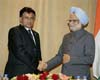 Karachi (AFP) Nov 21, 2006
President Pervez Musharraf said Tuesday he is looking forward to "substantive" talks with Indian Prime Minister Manmohan Singh when he visits Pakistan. Musharraf told reporters in this southern port city that the two countries need to resolve all outstanding disputes, including Kashmir, the reason for two of their three wars. |
|
|

| The content herein, unless otherwise known to be public domain, are Copyright 1995-2006 - SpaceDaily.AFP and UPI Wire Stories are copyright Agence France-Presse and United Press International. ESA PortalReports are copyright European Space Agency. All NASA sourced material is public domain. Additionalcopyrights may apply in whole or part to other bona fide parties. Advertising does not imply endorsement,agreement or approval of any opinions, statements or information provided by SpaceDaily on any Web page published or hosted by SpaceDaily. Privacy Statement |