|
 |
 |
 |
 |
 |
 |
 |
 |

 |
NASA's Spacecraft Help Solve Saturn's Mysterious Auroras
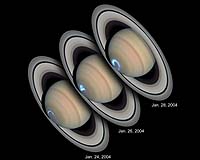
Pasadena CA (JPL) Feb 17, 2005 The dancing light of Saturn's auroras behaves in ways different from how scientists thought possible. New research has overturned theories, accepted for the past 25 years, about how Saturn's magnetic field behaves and how auroras are generated. Researchers choreographed the instruments aboard NASA's Hubble Space Telescope and the Cassini spacecraft to help solve the long-standing saturnian mystery. The researchers, led by John Clarke of Boston University, found the planet's auroras, long thought of as a cross between those of Earth and Jupiter, are fundamentally unlike those observed on either of the other two planets. The ruby-colored lights that occasionally paint the sky over Saturn may be a phenomenon unique within our solar system. In Clarke's experiment, Hubble snapped ultraviolet pictures of Saturn's auroras over several weeks. Cassini recorded radio emissions from the same regions, while measuring the solar wind, a stream of charged particles that trigger auroras. The observations showed Saturn's auroras differ in character day to day, as they do on Earth. They move around on some days and remain stationary on others. Unlike Earth, where auroras can last for hours, Saturn's can last for days. Surprisingly, the observations also indicated the sun's magnetic field and solar wind may play a much larger role in Saturn's aurora than previously suspected. Hubble images, when combined with Cassini measurements of the solar wind, show it is the pressure of the solar wind that appears to drive auroral storms on Saturn. In Earth's case, it is mainly the sun's magnetic field, carried into the solar wind that drives auroral storms. Seen from space, an aurora appears as a ring of light circling a planet's polar region, where magnetic poles typically reside. Auroral displays are initiated when charged particles in space collide with a planet's magnetic field and stream into the upper atmosphere. Collisions with gases in the planet's atmosphere produce flashes of glowing energy in the form of light and radio waves. When Saturn's auroras become brighter and more powerful, the ring of energy encircling the pole shrinks in diameter. When Earth's auroras become brighter, the polar region is filled with light for several minutes. Then the ring of light dims and begins to expand. Jupiter's auroras are not influenced by the solar wind, becoming brighter about once a month. Saturn's aurora displays also become brighter on the sector of the planet where night turns to day as the storms increase in intensity, unlike either of the other two planets. With Cassini orbiting Saturn, researchers will be able to take a more direct look at how the planet's auroras are generated. Researchers will probe how the sun's magnetic field may fuel Saturn's auroras and study what role the solar wind may play. The study results appear in tomorrow's edition of the journal Nature. Electronic images, video and additional information about the study can be found at the Hubble Site's Newsdesk . CommunityEmail This Article Comment On This Article Related Links Cassini-Huygens at JPL Cassini Imaging Team SpaceDaily Search SpaceDaily Subscribe To SpaceDaily Express Explore The Ring World of Saturn and her moons Jupiter and its Moons The million outer planets of a star called Sol News Flash at Mercury
 Cassini Images Halo Around Titanic Moon Off Saturn
 Pasadena CA (SPX) Dec 27, 2005
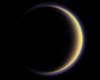
With its thick, distended atmosphere, Titan's orange globe shines softly, encircled by a thin halo of purple light-scattering haze. |
|
|

| The content herein, unless otherwise known to be public domain, are Copyright 1995-2006 - SpaceDaily.AFP and UPI Wire Stories are copyright Agence France-Presse and United Press International. ESA PortalReports are copyright European Space Agency. All NASA sourced material is public domain. Additionalcopyrights may apply in whole or part to other bona fide parties. Advertising does not imply endorsement,agreement or approval of any opinions, statements or information provided by SpaceDaily on any Web page published or hosted by SpaceDaily. Privacy Statement |