|
 |
 |
 |
 |
 |
 |
 |
 |

 |
NASA's New Vision Inspires Students In Great Moonbuggy Race
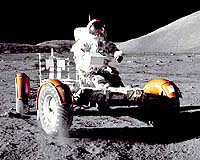
Huntsville - Feb 27, 2004 Student teams from New Jersey to Arizona are creating human-powered vehicles, similar to the first vehicles that roamed the lunar surface in the 1960s, to compete in NASA's Great Moonbuggy Race in Huntsville , Ala. , April 2-3. On Jan. 14, as President Bush announced new goals for America 's space program to return to the Moon and explore beyond, students across the nation were already working to support the new NASA vision for space exploration. Students are undertaking their moonbuggy projects hoping the skills they learn now may one day put them on the Moon, or that their designs someday may be used on the lunar or Martian surface. Their challenge, and the Great Moonbuggy competition, is inspired by the first lunar roving vehicles, created more than 40 years ago at NASA's Marshall Space Flight Center in Huntsville , Ala. Building a racing buggy gives students hands-on experience that could pay off in returning humans to the Moon, and journeying to Mars and beyond. "The Great Moonbuggy Race is an excellent example of how NASA is inspiring young people and at the same time aligning its education outreach with the President's new vision," said Dr. Adena Williams Loston, NASA's Associate Administrator for Education. The teams competing in the Great Moonbuggy Race encounter some of the same challenges conquered by the original Lunar Rover team in the 1960s. That team was challenged to design a vehicle that was compact, durable and able to handle the rigors of a tough, unflinching environment. Team members met that challenge. Astronauts used separate Lunar Rovers on the final three Moon missions � Apollo 15, 16 and 17 � to travel 52.51 miles (84.5 kilometers), gather 620.6 pounds (281.5 kilograms) of rock and soil samples, and return them to Earth. "This competition prepares young men and women to study science, technology, engineering and technology needed to take explorers to the Moon and Mars," said Durlean Bradford, Moonbuggy Race coordinator in Marshall 's education department. "Some of these moonbuggy racers could be chosen to make the trips or design and build the machines that will help our nation reach those goals. That's something to be excited about." The student's Moonbuggy challenge is to design a human-powered vehicle able to fit into a space no more than 4-feet by 4-feet by 4-feet that also must be quickly unfolded and ready to ride, yet light enough for its two drivers to carry. During the race, the two operators � one male, one female � power and drive the vehicle over a half-mile obstacle course of simulated moonscape terrain. Although the moonbuggy racers don't haul soil and rock, they do encounter many of the same design and engineering problems faced by that original lunar rover team. In addition to working issues of design, fabrication and teamwork, the budding student engineers must make sure the buggies work and can withstand the punishment of the rigorous course obstacles. In addition, riders must be in top physical condition to pedal the tough course. In 2003, 55 teams from 20 states and Puerto Rico participated. This year, high school teams will race April 2 and college teams will compete April 3. But it's more than just a race. It's the continuation of a challenge faced more than 30 years ago. "For some schools, this challenge has become part of their curriculum," Bradford said. "They work on their moonbuggies for several months before making the trip to Huntsville to compete. We're expecting big fields this year, both in the high school and college races." Prizes are awarded not only for the fastest vehicles, but also to the team whose design represents the best technical approach to solving the engineering problem of navigating a simulated lunar surface. Community Email This Article Comment On This Article Related Links Lunar Dreams at Marshall SpaceDaily Search SpaceDaily Subscribe To SpaceDaily Express Stellar Chemistry, The Universe And All Within It
 Sloan Survey Identifies New Dwarf Galaxy Inside Milky Way
 Washington DC (SPX) Jan 10, 2006
Astronomers using the Sloan Digital Sky Survey have discovered a previously unknown cluster of stars within the Milky Way that appears to be a separate dwarf galaxy being consumed by its much larger neighbor. |
|
|

| The content herein, unless otherwise known to be public domain, are Copyright 1995-2006 - SpaceDaily.AFP and UPI Wire Stories are copyright Agence France-Presse and United Press International. ESA PortalReports are copyright European Space Agency. All NASA sourced material is public domain. Additionalcopyrights may apply in whole or part to other bona fide parties. Advertising does not imply endorsement,agreement or approval of any opinions, statements or information provided by SpaceDaily on any Web page published or hosted by SpaceDaily. Privacy Statement |