|
 |
 |
 |
 |
 |
 |
 |
 |

 |
NASA's Famed B-52B "Mothership" Aircraft To Retire
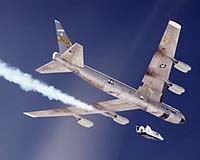
Edwards AFB CA (SPX) Dec 09, 2004 Having dropped advanced flight research vehicles rather than bombs over an illustrious career spanning nearly a half century, NASA's B-52B "mothership" air-launch aircraft is being retired. The Air Force Flight Test Center and NASA Dryden Flight Research Center will jointly host a formal retirement ceremony for the revered aircraft at 10 a.m. on Dec. 17, 2004 at NASA Dryden, located on Edwards Air Force Base, Calif. The ceremony will include a formal transfer of the B-52B by NASA Dryden center director Kevin Petersen to Brig. Gen. Curtis M. Bedke, commander of the Air Force Flight Test Center, for its final disposition. Tentative plans call for placing the aircraft on permanent display at Edwards AFB. Operated by NASA Dryden for most of its lifetime, NASA's venerable B-52B has participated in some of the most significant projects in aerospace history. At retirement, the air launch and research aircraft holds the distinction of being NASA's oldest aircraft, as well as being the oldest B-52 still flyable. At the same time, it has the lowest number of flying hours of any B-52 in operation, having been used exclusively in the role it has continued to perform so reliably for nearly 50 years. Bearing NASA tail number 008, the B-52B first flew in June 1955 and was flown by the Air Force in the B-52 test program for several years before it was modified to support the X-15 research aircraft program at NASA Dryden in 1959. It flew its last research mission Nov. 16, 2004, launching the scramjet-powered X-43A on its record Mach 9.6 flight over the Pacific Ocean. Community Email This Article Comment On This Article Related Links SpaceDaily Search SpaceDaily Subscribe To SpaceDaily Express Aerospace News at SpaceMart.com
 Northrop Grumman To Provide New Air Data Inertial Reference Units To Lufthansa
 Woodland Hills CA (SPX) Jan 12, 2006
Lufthansa will be one of the first commercial air carriers worldwide to benefit from the latest air data inertial reference units from Northrop Grumman. Inertial reference units provide aircrews with essential aircraft operational data such as aircraft position, velocities, attitude, altitude, air speed and many other parameters. |
|
|

| The content herein, unless otherwise known to be public domain, are Copyright 1995-2006 - SpaceDaily.AFP and UPI Wire Stories are copyright Agence France-Presse and United Press International. ESA PortalReports are copyright European Space Agency. All NASA sourced material is public domain. Additionalcopyrights may apply in whole or part to other bona fide parties. Advertising does not imply endorsement,agreement or approval of any opinions, statements or information provided by SpaceDaily on any Web page published or hosted by SpaceDaily. Privacy Statement |