|
 |
 |
 |
 |
 |
 |
 |
 |

 |
NASA's Astronaut Class Outwits, Outlasts First Year Of Training
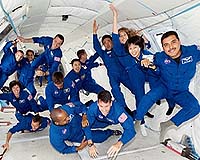
Pensacola NAS FL (SPX) May 09, 2005 They were ejected, spun, strapped, blindfolded, dunked in water, looped, rolled, flipped, floated, left in a forest, taught to eat leaves and roots, "injured" and rescued. It may sound a lot like a script from a hit reality show, but these challenges surpassed any task ever seen on an episode of 'Survivor' or 'Fear Factor.' Today, NASA's astronaut candidates selected May 6, 2004, mark a major milestone � completion of a year of training toward becoming the next generation explorers of space. Survival is the most critical factor in human space exploration. Unlike the reality shows of television, however, survival is based on teamwork rather than elimination. "Working as a team, whether it was through water survival training, ground or flight training, has been the most valuable lesson we've learned so far," said Educator Astronaut Joe Acaba. "Those stronger in some areas helped others and vice versa. We got through it all together." The candidates who were � 12 months ago � mere strangers now consider each other as family. It is through this common bond that their teamwork is recognized. "They have great enthusiasm for every challenge and have tremendous dedication to each other, which makes them a special group," said Astronaut George Zamka, astronaut candidate class mentor. "You can take a lot of real smart, real aggressive individuals and put them together in one place, but you don't get a team like they have unless each one decides to put the team first." Most of the class of 2004 astronaut candidates � a group of teachers, doctors, scientists, engineers, military pilots and a Navy SEAL � met for their first training assignment at the Pensacola Naval Air Station in Florida to start what would soon become only the beginning of extreme challenges of wit and tenacity. Pilots Jim Dutton and Randy Bresnik, and Mission Specialist Shane Kimbrough, who had already had military water survival training, met the rest of the class later in Houston for their next training missions. Tapping into a diverse knowledge base, this class includes three educator astronauts chosen by NASA to help inspire explorers of tomorrow. "Having the educator astronauts in the group, helps make us mini-educators to be more effective at inspiring the next generation of explorers," Pilot Randy Bresnik said. Mission Specialist Shannon Walker added that having the international partners in the class proves to be just as valuable to the class as a whole. Three Japan Aerospace Exploration Agency (JAXA) astronauts: Akihiko Hoshide, Satoshi Furukawa and Naoko Yamazaki, are training with the 11-member astronaut candidate class. "Space exploration is an international endeavor," said Duane Ross, astronaut training program manager at the Johnson Space Center. "To work with these people on a day-to-day basis can only add to that partnership to make space exploration successful." Weeks of water survival activities, ejection techniques and T-34 simulations were followed by T-38 jet flights, emergency landing practices and virtual reality parachute jumps all interspersed with studying flight texts and procedural manuals. The astronauts in training then took a field trip to the wilderness of Maine and learned how to live off the land using its natural resources and their own ingenuity and teamwork. After visiting each NASA center to learn more about the scientific research behind the scenes, they got a feel for weightlessness and a 20-second walk on the Moon and another on Mars aboard the KC-135 aircraft. Rollercoaster-like rises and falls, which simulate the weightless environment of space on the aircraft, were a collective favorite among the astronaut candidates. "It's all about the zero-g," Mission Specialist Jose Hernandez said with a grin. With only eight months left until completion of their initial training, the astronaut candidates are now hitting the books and spending a lot of time in classrooms. They are studying everything on the Orbiter systems, ranging from propulsion to environmental controls and all areas of Shuttle vehicle operations. The astronaut candidates have begun to study Russian and will soon embark on learning about the International Space Station, astronauts' orbiting home away from home while in space. "We've been very happy with this group," Ross said. "They're a wonderful close-knit group, a great group to work with." Selected as the first astronaut class since the President announced the nation's Vision for Space Exploration, the class of 2004 meets tough expectations. Preparing for spaceflight is hard work. Preparing to take the next steps on a journey that will take man back to the Moon and onward to Mars is even more difficult, but is something this elite class looks forward to. "Adding the human element to the Vision and seeing the agency take actual steps toward that vision is the best part of this," said Educator Astronaut Dottie Metcalf-Lindenburger. The entire class agrees, "It's exciting." Community Email This Article Comment On This Article Related Links Naval Air Station Pensacola SpaceDaily Search SpaceDaily Subscribe To SpaceDaily Express Space Shuttle News at Space-Travel.Com
 Heads Up, Space Station, Discovery Is Ready To Blast Off
 Cape Canaveral (AFP) Jul 12, 2005
A plastic and foam cover fell off a window of Discovery, but damage to the space shuttle was rapidly fixed and will not cause any delays, NASA said Tuesday on the eve of the planned launch. |
|
|

| The content herein, unless otherwise known to be public domain, are Copyright 1995-2006 - SpaceDaily.AFP and UPI Wire Stories are copyright Agence France-Presse and United Press International. ESA PortalReports are copyright European Space Agency. All NASA sourced material is public domain. Additionalcopyrights may apply in whole or part to other bona fide parties. Advertising does not imply endorsement,agreement or approval of any opinions, statements or information provided by SpaceDaily on any Web page published or hosted by SpaceDaily. Privacy Statement |