|
 |
 |
 |
 |
 |
 |
 |
 |

 |
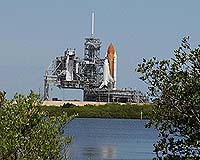
NASA scrubs Atlantis launch for fourth time
Cape Canaveral, Florida (AFP) Dec 9, 2007 A planned launch of the US space shuttle Atlantis was scrubbed again early Sunday after NASA engineers discovered that one of the sensors on the spacecraft's hydrogen fuel tank failed during morning tests. The decision, taken by flight managers at 7:24 am (1224 GMT), marks the fourth delay in the launch of the spacecraft that was to head for the International Space Station with a European laboratory on board. "The mission management team has officially scrubbed the launch for today," National Aeronautics and Space Agency TV commentator George Diller announced. Under NASA rules, all four fuel sensors have to be working properly for the launch to proceed. There are only a few days left in which conditions will be right for the shuttle to launch from Earth to reach the space station. Shuttle program manager Wayne Hale said a launch may be possible up until Friday. Atlantis's launch, initially scheduled for Thursday, was initially postponed after fuel two of the sensors gave false readings during fueling, requiring engineers to investigate what NASA described as a very complex problem. The Atlantis crew of seven is preparing for an 11-day mission to fly the European Columbus laboratory to the space station, orbiting hundreds of miles above Earth. Until now, only the United States and Russia have had their own laboratories at the ISS. "We have never had a permanent base in space before and I see that like a first step for Europe in the real spaceflight activities compared to what we had in the past," said Leopold Eyharts, a French astronaut who works for the European Space Agency. Eyharts is part of the Atlantis crew and will stay behind at the ISS for two and a half months to prepare Columbus for future scientific work. Other crew members include Commander Steve Frick, Pilot Alan Poindexter, mission specialists Leland Melvin, Rex Walheim, Stanley Love and another European Space Agency astronaut, Hans Schlegel of Germany. With Columbus, Europe hopes to become an integral part of the only functioning orbital outpost, whose scientific experiments with microgravity are considered essential to prepare human kind for long-term life and work in space and subsequent journeys towards Mars and beyond. Columbus will allow astronauts to conduct hundreds of experiments a year, notably in areas of biotechnology, medicine, materials and fluids. Designed to be carried in the hold of the shuttle, the European laboratory is cylindrical shaped; 6.87 meters (yards) long and 4.49 meters in diameter. Columbus weighs 10.3 tons when empty and 19.3 tons fully loaded. It can accommodate up to three persons and carry 10 research equipment units. Construction of the space laboratory, which cost close to a billion euros, began in 1992. Initially it was planned that Columbus would be flown to the ISS at the end of 2004. But the tragic end of the shuttle Columbia in February 2003 had resulted in the grounding of the three remaining shuttle orbiters for two years, which in turn delayed the laboratory's launch. Columbus will be controlled from a German space operations center located in Oberpfaffenhofen, close to Munich. Germany is by far the biggest contributor of this project, financing 41 percent of the total cost. Italy contributed 23 percent and France 18 percent. In all, 10 European countries participate in the program. The Japanese laboratory Kibo, the fourth planned component of the ISS which is to be the largest and most sophisticated of all, should be delivered in three shuttle flights, the first of which is scheduled for February 2008. Community Email This Article Comment On This Article Related Links Shuttle at NASA Watch NASA TV via Space.TV Space Shuttle News at Space-Travel.Com
 Glitch Delays Shuttle Launch Until At Least Saturday
 Cape Canaveral, Florida (AFP) Dec 6, 2007
NASA postponed the planned launch of the space shuttle Atlantis from Friday to Saturday, due to a "complex" technical glitch just hours before it was due to blast off. |
|
|

| The content herein, unless otherwise known to be public domain, are Copyright 1995-2007 - SpaceDaily.AFP and UPI Wire Stories are copyright Agence France-Presse and United Press International. ESA Portal Reports are copyright European Space Agency. All NASA sourced material is public domain. Additional copyrights may apply in whole or part to other bona fide parties. Advertising does not imply endorsement,agreement or approval of any opinions, statements or information provided by SpaceDaily on any Web page published or hosted by SpaceDaily. Privacy Statement |