
 |
 |
 |
 |
 |
 |
 |
 |
 |

 |
NASA launches probe to study edge of solar system
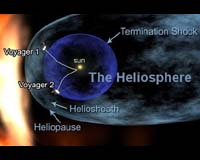
Washington (AFP) Oct 19, 2008 NASA on Sunday launched a probe into orbit high above earth to study the distant edge of the solar system where hot solar winds crash into the cold outer space. The Interstellar Boundary Explorer (IBEX) was launched at 1745 GMT, according to images broadcast live by the US space agency. The small probe was deployed on a Pegasus rocket which dropped from the bay doors of a Lockheed L-1011 jet flying at 12,000 meters (40,000 feet) over the southern Pacific Ocean near the Marshall Islands. "The count went really smooth... and everything appears to be going well," NASA assistant launch manager Omar Baez said shortly after the launch. The IBEX is on a two-year mission to take pictures and chart the mysterious confines of the solar system -- including areas billions of kilometers (miles) from earth. The small, stop-sign-shaped probe is equipped with instruments that will allow it to take images and chart, for the first time, a remote region known as the interstellar boundary, where the solar system meets interstellar space. The area is a vast expanse of turbulent gas and twisting magnetic fields. "The interstellar boundary regions are critical because they shield us from the vast majority of dangerous galactic cosmic rays, which otherwise would penetrate into Earth's orbit and make human spaceflight much more dangerous," David McComas, IBEX principal investigator from the Southwest Research Institute (SwRI) in San Antonio, Texas, said recently. The only information that scientists have of this distant region is from the twin Voyager 1 and 2 probes, launched in 1977 and still in service today. The two probes have travelled past the inner solar system, where the planets are, and on their way to its farthest edge. In December 2004 Voyager 1 reached an area that scientists describe as the "termination shock" zone, where solar winds crash into the gas of interstellar space, marking the boundary of the solar system. "The Voyager spacecraft are making fascinating observations of the local conditions at two points beyond the termination shock that show totally unexpected results and challenge many of our notions about this important region," said McComas. In 2007 Voyager 2 reached the heliosheath -- the area where the termination shock begins -- and on its current path and speed, should reach the heliopause -- the boundary between solar winds and interstellar winds -- in 2010. The National Aeronautics and Space Administration (NASA) remains in regular contact with the two probes, which return data recorded by their particle detectors. By 2020 however, contact with Voyager probes will be lost because of the weakening of their plutonium generators. IBEX, armed with two very large aperture single pixel "cameras" that measure energetic neutral atoms, is to produce images of the region that will allow scientists for the first time to better understand what happens where the solar system meets the galaxy. The mission will also study cosmic radiation, which has a negative impact on human health and space exploration. The IBEX probe weighs 462 kilos (1016 pounds) and is shaped like an octagon, measuring a mere 52 centimeters (23 inches) high and 97 centimeters (38 inches) across. The Pegasus put the IBEX in a low orbit some 96 kilometers (60 miles) above Earth. The IBEX spacecraft's own solid rocket motor will then carry the probe into a much higher altitude orbit of around 200,000 miles, NASA said. Community Email This Article Comment On This Article Share This Article With Planet Earth
Related Links Stellar Chemistry, The Universe And All Within It
 New Milky Way Map Reveals A Complicated Outer Galaxy
 Chicago IL (SPX) Aug 15, 2008
The halo of stars that envelops the Milky Way galaxy is like a river delta criss-crossed by stellar streams large and small, according to new data from the Sloan Digital Sky Survey (SDSS-II). |
|
|

| The content herein, unless otherwise known to be public domain, are Copyright 1995-2007 - SpaceDaily.AFP and UPI Wire Stories are copyright Agence France-Presse and United Press International. ESA Portal Reports are copyright European Space Agency. All NASA sourced material is public domain. Additional copyrights may apply in whole or part to other bona fide parties. Advertising does not imply endorsement,agreement or approval of any opinions, statements or information provided by SpaceDaily on any Web page published or hosted by SpaceDaily. Privacy Statement |
 del.icio.us
 Digg
Digg Reddit
 YahooMyWeb
 Google
 Facebook