|
 |
 |
 |
 |
 |
 |
 |
 |

 |
NASA, U.S. Coast Guard Partner To Track, Protect Aircraft Parts
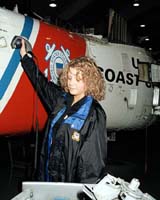
Huntsville - Apr 14, 2004 NASA and the U.S. Coast Guard are teaming to apply an innovative NASA identification system to flight safety-critical aircraft parts - helping the Coast Guard track its property on land and sea, and providing insurance against the use of unauthorized replacement parts. The "Data Matrix" ID technology compresses information into a two-dimensional, barcode-type format. Developed at NASA's Marshall Space Flight Center in Huntsville, Ala., to track aerospace industry parts, the marking technology can be applied with a laser or other secure methods, eliminating the need for paper labels or tags. The matrix symbol - a small, square mark resembling a checkerboard and capable of holding up to 100 times more information than a typical barcode - is permanently imprinted on the part, detectable on the surface of the part with a handheld optical reader, or even through several layers of paint, using a magnetic scanner. That approach drew the interest of the Coast Guard in 1996. The maritime military organization - now a key component of the Department of Homeland Security - was seeking ways to improve property tracking and guarantee the quality of the parts it receives from aviation parts suppliers, with the aim of eliminating counterfeit or unapproved parts. According to Capt. Bruce Drahos, commanding officer at the Coast Guard Aircraft Repair and Supply Center in Elizabeth City, N.C. - which manages and repairs the organization's entire air fleet - the Coast Guard remains committed to detecting and prosecuting individuals who manufacture and sell unapproved aircraft parts, and those who repair, overhaul and resell scrapped or discarded parts. That meant finding a tamper-proof marking technology that would remain readable throughout the life of the part, with no detrimental effects on performance or reliability, and which could withstand the extreme environmental conditions routinely faced by the aircraft. Enter NASA technologists. "NASA had worked for years to answer the kinds of questions the Coast Guard was asking," said Fred Schramm, manager for Automatic Identification and Data Capture engineering projects at the Marshall Center's Technology Transfer Department. "It was a great opportunity to share the fruits of our research." The Repair and Supply Center teamed in 1997 with NASA and its commercial Data Matrix partners to begin marking safety-critical parts used in aircraft maintenance. The initial study, which ran until 1998, focused on applying and tracking Data Matrix marks on some 500 test parts. With Congressional encouragement, the second phase - begun in spring 2002 and supported by NASA and its commercial partner, Robotic Vision Systems Inc., of Nashua, N.H. - evaluated markings subjected to actual flight operations, including hardware found in helicopter rotor blades and aircraft engines. "Both studies were a great success and showed us this technology was practical and usable in our environment," said Terry Boyce, investigative analyst and project leader at the Aircraft Repair and Supply Center. "The results showed us we needed to develop a plan for marking parts on a wider scale, eventually including every piece of property in our fleet." The next phase of the joint research effort includes marking the remaining flight safety-critical aircraft parts in the Coast Guard inventory, and expanding the Data Matrix marking process to include the surface fleet, small-firearms inventory and its aircraft maintenance-related hand tools. The study also includes training Coast Guard personnel to apply and read the markings and to properly apply the technology in the field - part of the study Schramm believes will be most beneficial to the Guard. "The Data Matrix technology has unlimited applications in public and private industry," Schramm said. "Knowing those who protect America's shores are using the system to ensure the integrity of their vehicles and hardware proves everyone, including NASA, has a role to play in the safety of the world in which we live." Community Email This Article Comment On This Article Related Links Marshall Space Flight Center SpaceDaily Search SpaceDaily Subscribe To SpaceDaily Express Space Tourism, Space Transport and Space Exploration News
 NASA Refines Design For Crew Exploration Vehicle
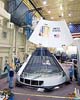 Washington DC (SPX) Jan 12, 2006
NASA's Constellation Program is making progress toward selecting a prime contractor to design, develop and build the Crew Exploration Vehicle (CEV), America's first new human spacecraft in 30 years. |
|
|

| The content herein, unless otherwise known to be public domain, are Copyright 1995-2006 - SpaceDaily.AFP and UPI Wire Stories are copyright Agence France-Presse and United Press International. ESA PortalReports are copyright European Space Agency. All NASA sourced material is public domain. Additionalcopyrights may apply in whole or part to other bona fide parties. Advertising does not imply endorsement,agreement or approval of any opinions, statements or information provided by SpaceDaily on any Web page published or hosted by SpaceDaily. Privacy Statement |