|
 |
 |
 |
 |
 |
 |
 |
 |

 |
NASA To Use Balloon Flotilla To Study Radiation That Affects Earth
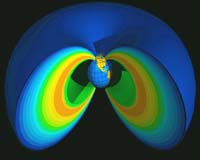
Washington DC (SPX) Dec 06, 2007 A new NASA project will use more than 40 high altitude balloons to return new scientific insights about Earth's Van Allen Belts. The type of radiation in the belts can be hazardous to astronauts, orbiting satellites and aircraft flying in high altitude polar routes. NASA's Science Mission Directorate, Washington, has awarded $9.3 million to Dartmouth College of Hanover, N.H., for the study. Research using the balloons can be carried out at a fraction of the cost of using an orbiting satellite. The new mission is called the Balloon Array for Radiation-belt Relativistic Electron Losses, or BARREL. The mission's principal investigator is Robyn Millan of Dartmouth. BARREL will fly in 2013 and 2014, and will provide answers to how and where the Van Allen Belts, discovered in 1958, periodically drain into Earth's upper atmosphere. BARREL will fly in conjunction with NASA's Radiation Belt Storm Probes satellites, due to launch in 2011. "The study of near-Earth radiation is very important," said John Mather, Nobel Prize recipient and chief scientist of NASA's Science Mission Directorate. "This research will provide information to mitigate problems here on our planet as well as permit better design and operations of new technology in space and safer passage for space explorers." The Van Allen Belts are a ring of energetic charged particles that encircle Earth and are constrained by Earth's magnetic field. Outbursts from the sun can pump additional energy and particles into the radiation belts, allowing them to drain again in a matter of days or weeks. The balloons will be launched from Antarctica. They will expand to roughly the size of a large blimp when they reach the near-space research altitude. A single balloon of this type will hover at an altitude of approximately 21 miles for as long as two weeks. By carefully timing the launch of a series of balloons, about one per day, Millan and her group of young scientists in training can form a ring of balloons encircling the South Pole to study the total influx of radiation from the belts into Earth's atmosphere. "This experiment will be the first of its kind in establishing a web of balloon-borne sensors working hand-in-hand with a satellite mission," said Dick Fisher, director of NASA's Heliophysics Division, Washington. "In addition to the groundbreaking science that BARREL will provide, this kind of use of NASA's suborbital program is vital for training the next generation of scientists in a wide range of areas." The Radiation Belt Storm Probes satellites are part of NASA's Living with a Star Program that is designed to understand how and why the sun varies, how planetary systems respond and how human activities are affected. NASA's Goddard Space Flight Center, Greenbelt, Md., manages the program for the Science Mission Directorate. Community Email This Article Comment On This Article Related Links NASA Living with a Star Program Solar Science News at SpaceDaily
 Ulysses' Mission Extended
 Paris, France (ESA) Nov 19, 2007
ESA's Science Programme Committee has unanimously approved to continue the operations of the highly successful Ulysses spacecraft until March 2009. This latest extension, for a period of 12 months, is the fourth in the history of the joint NASA/ESA mission. In addition to pursuing its long-term goal of exploring the heliosphere in four dimensions - 3 spatial dimensions and time - Ulysses is a key member of the Heliospheric Network, the international fleet of spacecraft presently operating at many different locations in the heliosphere and beyond. |
|
|

| The content herein, unless otherwise known to be public domain, are Copyright 1995-2007 - SpaceDaily.AFP and UPI Wire Stories are copyright Agence France-Presse and United Press International. ESA Portal Reports are copyright European Space Agency. All NASA sourced material is public domain. Additional copyrights may apply in whole or part to other bona fide parties. Advertising does not imply endorsement,agreement or approval of any opinions, statements or information provided by SpaceDaily on any Web page published or hosted by SpaceDaily. Privacy Statement |