
 |
 |
 |
 |
 |
 |
 |
 |
 |

 |
NASA To Attempt Historic Solar Sail Deployment
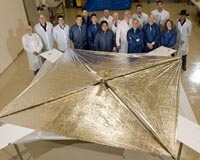
for NASA Science News Huntsville AL (SPX) Jun 30, 2008 "Hold your hands out to the sun. What do you feel? Heat, of course. But there's pressure as well - though you've never noticed it, because it's so tiny. Over the area of your hands, it only comes to about a millionth of an ounce. "But out in space, even a pressure as small as that can be important - for it's acting all the time, hour after hour, day after day. Unlike rocket fuel, it's free and unlimited. If we want to, we can use it; we can build sails to catch the radiation blowing from the sun."1 These words were spoken not by a NASA scientist but by a fictional character - John Merton - in Arthur C. Clarke's short story The Wind from the Sun. If all goes well, Merton's prophetic words are about to become fact. NASA researchers, thinking "out of the box" (or maybe "out of the rocket") have long dreamed of the possibility of sailing among the planets with sails propelled by sunlight instead of by wind. Except in works of fiction, though, no one has yet successfully deployed such a sail anywhere beyond Earth. "There's a first time for everything," says Edward "Sandy" Montgomery of NASA's Marshall Space Flight Center. Montgomery's team and a team from Ames Research Center (led by Elwood Agasid) hope to make history this summer by deploying a solar sail called NanoSail-D. It will travel to space onboard a SpaceX Falcon 1 rocket, scheduled for launch from Omelek Island in the Pacific Ocean during a window extending from July 29th to August 6th (a back-up window extends from August 29th to September 5th). "NanoSail-D will be the first fully deployed solar sail in space, and the first spacecraft to use solar pressure as a primary means of attitude control or orbital maneuvering," says Montgomery, who is NanoSail-D's payload manager. "We are always on the lookout for opportunities. Ames owns a slot on the Falcon 1 launch and asked us if we wanted to go along. We said, 'Yes!' We'll use the Poly Picosatellite Orbital Deployer, or P-POD, developed by the University of California Polytechnic Institute to deploy our sail." A few years ago, the Planetary Society attempted a mission like NanoSail-D called Cosmos I, but the launch vehicle failed and destroyed the undeployed spacecraft. Montgomery and team believe that NanoSail-D, however, will unfurl four gossamer wings from its pod in the blackness of space like a butterfly from a cocoon: movie. "The structure is made of aluminum and space-age plastic," says Montgomery. "The whole spacecraft weighs less than ten pounds. We carry it around in a special suitcase -- airplane carry-on luggage size." Fully opened, the kite-shaped sail spreads out to about 100 square feet of light-catching surface. "A success would be huge for the future of space exploration," Montgomery believes. Why so important? Solar sails could extend our reach as far as our dreams. Because there's no friction in space, once a solar sail starts moving, it can go on forever. Indeed, long after a rocket would run out of gas and begin to coast, a solar sailship could still be accelerating, achieving speeds much faster and covering distances far greater than any rocket. No rocket in existence could carry enough fuel to reach the outer solar system in as short a time. And like a marine sail, a solar sail could also bring you home. You could use the solar sail to tack your vessel, making it travel "against the wind," back to Earth. "It's not so much about how far a sail will go compared to a rocket; the key is how fast," says Montgomery. "The Voyagers have escaped the solar system, and they were sent by rockets, but it's taken more than three decades to do it. A sail launched today would probably catch up with them in a single decade. Sails are slower to get started though. So, for example, between the Earth and the moon, rockets might be preferred for missions with a short timeline. It's a trip of days for rockets, but months for a solar sail. The rule of thumb, therefore, would be to use rockets for short hops and solar sails for the long hauls." All of this may sound like speculation, but NanoSail-D could show that solar sails are truly feasible. And there's an added bonus to this technology demo: "Currently, micro-satellites in orbit above a few hundred kilometers can stay in orbit for decades after completing their mission," explains Montgomery. "This creates an orbital debris collision risk for other spacecraft. NanoSail-D will demonstrate the feasibility of using a drag sail to decrease the time satellites clutter up Earth's orbit. "Although our sail looks like a kite, it will act like a parachute (or like a drag sail) in the very thin upper atmosphere around Earth. It will slow the spacecraft and make it lose altitude, re-enter the Earth's atmosphere and burn off in a relatively short period of time. A drag sail is a lighter alternative to carrying a propulsion system to de-orbit a satellite." And finally, the question everyone wants answered: What does D stand for? "We chose the 'D' in the name, not because it came after models A, B, and C, but because it can stand for demonstrate, deploy, drag, and/or de-orbit," says Montgomery. Soon, 'D' may stand for something new: "DID IT!" Check Science@NASA post-launch and the meaning will be revealed. Community Email This Article Comment On This Article Share This Article With Planet Earth
Related Links Life Beyond Earth Lands Beyond Beyond - extra solar planets - news and science
 100 Years Of Space Rock: The Tunguska Impact
 Pasadena CA (SPX) Jun 30, 2008
At around 7:17 on the morning of June 30, 1908, a man based at the trading post at Vanavara in Siberia is sitting on his front porch. In a moment, 40 miles from the center of an immense blast of unknown origin, he will be hurled from his chair and the heat will be so intense he will feel as though his shirt is on fire. |
|
|

| The content herein, unless otherwise known to be public domain, are Copyright 1995-2007 - SpaceDaily.AFP and UPI Wire Stories are copyright Agence France-Presse and United Press International. ESA Portal Reports are copyright European Space Agency. All NASA sourced material is public domain. Additional copyrights may apply in whole or part to other bona fide parties. Advertising does not imply endorsement,agreement or approval of any opinions, statements or information provided by SpaceDaily on any Web page published or hosted by SpaceDaily. Privacy Statement |
 del.icio.us
 Digg
Digg Reddit
 YahooMyWeb
 Google
 Facebook