
 |
 |
 |
 |
 |
 |
 |
 |
 |

 |
NASA Tests Moon Imaging Spacecraft
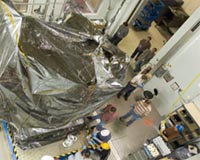
Greenbelt MD (SPX) Aug 01, 2008 NASA's Lunar Reconnaissance Orbiter, also known as LRO, has completed the first round of environmental testing at NASA's Goddard Space Flight Center in Greenbelt, Md. These tests ensure the spacecraft is prepared for its mission to collect the highest resolution images and most comprehensive geological data set ever returned from the moon. The objective of the mission is to map the lunar surface in preparation for human missions to the moon, which are planned to occur by 2020. The first two tests for the orbiter were the spin test and vibration test. The spin test determines the spacecraft's center of gravity and measures characteristics of its rotation. During vibration testing, engineers checked the structural integrity of the lunar probe aboard a large, shaking table that simulated the rigorous ride the orbiter will encounter during liftoff aboard an Atlas rocket. "It is during lift-off the spacecraft will be under the most stress," said Cathy Peddie, deputy project manager for LRO at Goddard. "We want to ensure the Lunar Reconnaissance Orbiter can withstand the extreme conditions experienced during launch." The next hurdle for the orbiter is approximately four days of acoustics testing during which the bagged spacecraft is placed near multistory, wall-sized speakers that simulate the noise-induced vibrations of launch. Following acoustics testing, the spacecraft will undergo a daylong test that simulates the orbiter's separation from the rocket during launch. In late August, the spacecraft will begin approximately five weeks of thermal vacuum testing, which duplicates the extreme hot, cold and airless conditions of space. During the test, engineers will operate the orbiter and conduct simulated flight operations while the spacecraft is subjected to the extreme temperature cycles of the lunar environment. By the end of 2008, the Lunar Reconnaissance Orbiter will be transported to NASA's Kennedy Space Center in Florida for final launch preparations. The orbiter and the Lunar Crater Observation and Sensing Satellite, a mission to impact the moon in search of water ice, are scheduled to launch atop an Atlas V rocket from Cape Canaveral Air Force Station in Florida. The launch window opens Feb. 27, 2009, and continues through the end of March. The seven science instruments aboard the Lunar Reconnaissance Orbiter will develop highly detailed maps of the lunar surface that provide data about lunar topography, surface temperature, lighting conditions, mineralogical composition, and abundance of natural resources. Information from the robotic spacecraft will be used to select safe landing sites and assess potential outpost locations for future human missions to the moon. The spacecraft also will provide valuable information about the lunar radiation environment, enabling the development of effective mitigation strategies for human explorers. The Lunar Reconnaissance Orbiter will be in a polar orbit, unlike the Apollo missions that focused on gaining science from the area around the moon's equator. The spacecraft will spend at least a year in a low, polar orbit approximately 30 miles above the lunar surface, while the instruments work together to collect detailed information about the lunar environment. Community Email This Article Comment On This Article Share This Article With Planet Earth
Related Links Goddard Space Flight Center Mars News and Information at MarsDaily.com Lunar Dreams and more
 NASA Hosts International Meeting For Lunar Science Discussions
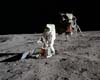 Moffett Field CA (SPX) Aug 01, 2008
NASA hosted a meeting of space agencies from nine countries last week to discuss the next steps in the ongoing scientific exploration of the moon. The meeting laid the groundwork for a new generation of lunar science. |
|
|

| The content herein, unless otherwise known to be public domain, are Copyright 1995-2007 - SpaceDaily.AFP and UPI Wire Stories are copyright Agence France-Presse and United Press International. ESA Portal Reports are copyright European Space Agency. All NASA sourced material is public domain. Additional copyrights may apply in whole or part to other bona fide parties. Advertising does not imply endorsement,agreement or approval of any opinions, statements or information provided by SpaceDaily on any Web page published or hosted by SpaceDaily. Privacy Statement |
 del.icio.us
 Digg
Digg Reddit
 YahooMyWeb
 Google
 Facebook