|
 |
 |
 |
 |
 |
 |
 |
 |

 |
NASA Telescope Launched On Japanese Suzaku Observatory
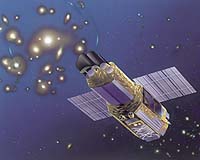
Greenbelt MD (SPX) Jul 13, 2005 A pioneering X-ray detector, developed jointly by NASA's Goddard Space Flight Center and the Institute of Space and Astronautical Science (ISAS) of the Japan Aerospace Exploration Agency (JAXA) was successfully launched Sunday (Japan Standard Time) on a major new space observatory. The high-resolution X-ray Spectrometer (XRS) was launched on board the Suzaku space observatory at 11:30 p.m. EDT, July 9 (12:30 p.m., July 10 local time) from Uchinoura Space Center in southern Japan. The highly anticipated Suzaku mission complements NASA's Chandra X-ray Observatory and the European Space Agency's XMM-Newton mission. The observatories support the study of exotic objects and regions in space that radiate predominantly in X-rays. Suzaku is a mythical, divine bird symbolizing renewal. It was previously called Astro-E2. Key targets for Suzaku include black holes; the million-degree gas from star explosions, which is filled with newly created elements such as oxygen and calcium; and the optically invisible gas between stars and galaxies, which comprises most of the ordinary mass in the universe. "Suzaku will fill a vital gap in our understanding of the X-ray universe," said Goddard's Dr. Richard Kelley, principal investigator for the U.S. contribution. Along with the XRS on Suzaku are four X-ray Imaging Spectrometer (XIS) instruments developed in collaboration among Japanese institutions and the Massachusetts Institute of Technology. The Hard X-Ray Detector (HXD), built by the University of Tokyo, ISAS and other Japanese institutions is also on board. The XRS and XIS instruments will analyze X-ray photons focused by individual telescopes. They were built at Goddard by a team led by Dr. Peter Serlemitsos, in cooperation with Nagoya University and other institutions in Japan. The HXD uses a tested yet improved technology. Suzaku launched on an M-V rocket and will attain a near-Earth, circular orbit at approximately 560 kilometers (345 miles). The observatory's expected mission lifetime is five years. Suzaku is the fifth in a series of Japanese satellites devoted to studying celestial X-ray sources. Community Email This Article Comment On This Article Related Links ASTRO-E2 at NASA SpaceDaily Search SpaceDaily Subscribe To SpaceDaily Express Space Telescope News and Technology at Skynightly.com
 UCSC Physicists Deliver Detector For NASA's GLAST Telescope
 Santa Cruz CA (SPX) Nov 09, 2005
After more than a decade of work, a team led by physicists at the University of California, Santa Cruz, has completed a major detector subsystem for NASA's Gamma-ray Large Area Space Telescope (GLAST).
--------------------------------------------------------- It's new. And it's downright terrific! Celestron's CPC Schmidt-Cassegrain telescope is the scope you've been waiting for! It offers new alignment technology, advanced engineering, and bold new design at a new, low price! In fact, Celestron's Professional Computerized (CPC) scope with revolutionary SkyAlign Alignment Technology redefines everything that amateur astronomers are looking for. It offers quick and simple alignment, GPS technology, unsurpassed optical quality, ease of use, advanced ergonomics, enhanced computerization and, most important, affordability. Want to view M-31 tonight? One button takes you there!
Shop for telescopes online at Telescopes.com! today!
|
|
|

| The content herein, unless otherwise known to be public domain, are Copyright 1995-2006 - SpaceDaily.AFP and UPI Wire Stories are copyright Agence France-Presse and United Press International. ESA PortalReports are copyright European Space Agency. All NASA sourced material is public domain. Additionalcopyrights may apply in whole or part to other bona fide parties. Advertising does not imply endorsement,agreement or approval of any opinions, statements or information provided by SpaceDaily on any Web page published or hosted by SpaceDaily. Privacy Statement |