|
 |
 |
 |
 |
 |
 |
 |
 |

 |
NASA Swift Mission Turns on and Sees a Blast of Bursts
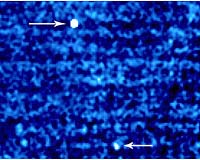
Washington (SPX) Jan 06, 2005 The NASA-led Swift mission opened its doors to a flurry of gamma ray burst action. Scientists were still calibrating the main instrument, the Burst Alert Telescope (BAT), when the first burst appeared on December 17. Three bursts on December 19, and one on December 20, followed. Swift's primary goal is to unravel the mystery of gamma ray bursts. The bursts are random and fleeting explosions, second only to the Big Bang in total energy output. Gamma rays are a type of light millions of times more energetic than light human eyes can detect. Gamma ray bursts last only from a few milliseconds to about one minute. Each burst likely signals the birth of a black hole. "The optimists among us were hoping to detect two bursts a week, not three in one day just after turning the telescope on," said Dr. Scott Barthelmy, the BAT lead scientist at NASA's Goddard Space Flight Center, Greenbelt, Md. "Maybe we got lucky, or maybe we've underestimated the true rate of these bursts. Only time will tell," he added. Once the BAT, that covers about one-seventh of the sky at any time, detects a gamma ray burst, it quickly relays a location to the ground. Within about one minute, the satellite automatically turns toward the burst. The move brings the burst within view of Swift's two other telescopes: the X-ray Telescope (XRT) and the Ultraviolet/Optical Telescope (UVOT). Once all three instruments are turned on and calibrated, Swift will get down to the business of analyzing gamma ray bursts. "The universe kept up its side of the bargain, and we kept up ours," said Dr. Neil Gehrels, Swift's Principal Investigator at Goddard. "This is going to be an exciting mission," he said. The Swift team tested the BAT by observing Cygnus X-1, a well-known bright source that produces gamma rays in our galaxy. It is thought to be a black hole in orbit around a star. The team called this BAT's "first light." The BAT is the most sensitive gamma ray detector ever flown. The BAT employs a novel technology to image and locate gamma ray bursts. Unlike visible light, gamma rays pass right through telescope mirrors and cannot be reflected onto a detector. The BAT uses a technique called "coded aperture mask" to create a gamma ray shadow on its detectors. The mask contains 52,000 randomly placed lead tiles that block some gamma rays from reaching the detectors. With each burst, some detectors light up while others remain dark, shaded by the lead tiles. The angle of the shadow points back to the gamma ray burst. "The BAT coded aperture mask is about the size of a pool table, the largest and most intricate ever fabricated," said Ed Fenimore of Los Alamos National Laboratory, N.M. Los Alamos created the BAT software. "BAT can accurately pinpoint a burst within seconds and detect bursts five times fainter than previous instruments," he added. Swift, a medium-class explorer mission managed by Goddard, was launched from Cape Canaveral on November 20, 2004. The mission is in participation with the Italian Space Agency and the Particle Physics and Astronomy Research Council in the United Kingdom. Swift was built at Goddard in collaboration with General Dynamics, Ariz.; Penn State University, College Station, Pa.; Sonoma State University, Rohnert Park, Calif.; Los Alamos; Mullard Space Science Laboratory, Surrey, England; the University of Leicester, England; the Brera Observatory, Milan, Italy; and ASI Science Data Center, Rome. Community Email This Article Comment On This Article Related Links Swift at NASA SpaceDaily Search SpaceDaily Subscribe To SpaceDaily Express Nuclear Space Technology at Space-Travel.com
 JHU-STScI Team Maps Dark Matter In Startling Detail
 Baltimore MD (SPX) Dec 12, 2005
Clues revealed by the recently sharpened view of the Hubble Space Telescope have allowed astronomers to map the location of invisible "dark matter" in unprecedented detail in two very young galaxy clusters.
--------------------------------------------------------- It's new. And it's downright terrific! Celestron's CPC Schmidt-Cassegrain telescope is the scope you've been waiting for! It offers new alignment technology, advanced engineering, and bold new design at a new, low price! In fact, Celestron's Professional Computerized (CPC) scope with revolutionary SkyAlign Alignment Technology redefines everything that amateur astronomers are looking for. It offers quick and simple alignment, GPS technology, unsurpassed optical quality, ease of use, advanced ergonomics, enhanced computerization and, most important, affordability. Want to view M-31 tonight? One button takes you there!
Shop for telescopes online at Telescopes.com! today!
|
|
|

| The content herein, unless otherwise known to be public domain, are Copyright 1995-2006 - SpaceDaily.AFP and UPI Wire Stories are copyright Agence France-Presse and United Press International. ESA PortalReports are copyright European Space Agency. All NASA sourced material is public domain. Additionalcopyrights may apply in whole or part to other bona fide parties. Advertising does not imply endorsement,agreement or approval of any opinions, statements or information provided by SpaceDaily on any Web page published or hosted by SpaceDaily. Privacy Statement |