|
 |
 |
 |
 |
 |
 |
 |
 |

 |
NASA Successfully Tests Ion Engine
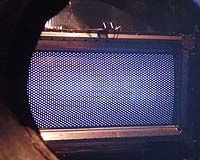
Washington - Nov 24, 2003 NASA's Project Prometheus recently reached an important milestone with the first successful test of an engine that could lead to revolutionary propulsion capabilities for space exploration missions throughout the solar system and beyond. The test involved a High Power Electric Propulsion (HiPEP) ion engine. The event marked the first in a series of performance tests to demonstrate new high-velocity and high- power thrust needed for use in nuclear electric propulsion (NEP) applications. "The initial test went extremely well," said Dr. John Foster, the primary investigator of the HiPEP ion engine at NASA's Glenn Research Center (GRC), Cleveland. "The test involved the largest microwave ion thruster ever built. The use of microwaves for ionization would enable very long-life thrusters for probing the universe," he said. The test was conducted in a vacuum chamber at GRC. The HiPEP ion engine was operated at power levels up to 12 kilowatts and over an equivalent range of exhaust velocities from 60,000 to 80,000 meters per second. The thruster is being designed to provide seven-to-ten-year lifetimes at high fuel efficiencies of more than 6,000-seconds specific impulse; a measure of how much thrust is generated per pound of fuel. This is a contrast to Space Shuttle main engines, which have a specific impulse of 460 seconds. The HiPEP thruster operates by ionizing xenon gas with microwaves. At the rear of the engine is a pair of rectangular metal grids that are charged with 6,000 volts of electric potential. The force of this electric field exerts a strong electrostatic pull on the xenon ions, accelerating them and producing the thrust that propels the spacecraft. The rectangular shape, a departure from the cylindrical ion thrusters used before, was designed to allow for an increase in engine power and performance by means of stretching the engine. The use of microwaves should provide much longer life and ion-production capability compared to current state-of- the-art technologies. This new class of NEP thrusters will offer substantial performance advantages over the ion engine flown on Deep Space 1 in 1999. Overall improvements include up to a factor of 10 or more in power; a factor of two to three in fuel efficiency; a factor of four to five in grid voltage; a factor of five to eight in thruster lifetime; and a 30 percent improvement in overall thruster efficiency. GRC engineers will continue testing and development of this particular thruster model, culminating in performance tests at full power levels of 25 kilowatts. "This test represents a huge leap in demonstrating the potential for advanced ion technologies, which could propel flagship space exploration missions throughout the solar system and beyond," said Alan Newhouse, Director, Project Prometheus. "We commend the work of Glenn and the other NASA Centers supporting this ambitious program." HiPEP is one of several candidate propulsion technologies under study by Project Prometheus for possible use on the first proposed flight mission, the Jupiter Icy Moons Orbiter (JIMO). Powered by a small nuclear reactor, electric thrusters would propel the JIMO spacecraft as it conducts close-range observations of Jupiter's three icy moons, Ganymede, Callisto and Europa. The three moons could contain water, and where there is water, there is the possibility of life. Development of the HiPEP ion engine is being carried out by a team of engineers from GRC; Aerojet, Redmond, Wash.; Boeing Electron Dynamic Devices, Torrance, Calif.; Ohio Aerospace Institute, Cleveland; University of Michigan, Ann Arbor, Mich.; Colorado State University, Fort Collins, Colo.; and the University of Wisconsin, Madison, Wis. Community Email This Article Comment On This Article Related Links Project Prometheus SpaceDaily Search SpaceDaily Subscribe To SpaceDaily Express Rocket Science News at Space-Travel.Com
 Successful First Test For Vega's Zefiro 9 Engine
 Paris, France(ESA) Dec 28, 2005
Flames, smoke and a deafening noise accompanied the first firing test of Vega's Zefiro 9 third-stage solid rocket motor. A first examination of the data indicates that everything went well at the test carried out yesterday at Salto de Quirra in southeast Sardinia. |
|
|

| The content herein, unless otherwise known to be public domain, are Copyright 1995-2006 - SpaceDaily.AFP and UPI Wire Stories are copyright Agence France-Presse and United Press International. ESA PortalReports are copyright European Space Agency. All NASA sourced material is public domain. Additionalcopyrights may apply in whole or part to other bona fide parties. Advertising does not imply endorsement,agreement or approval of any opinions, statements or information provided by SpaceDaily on any Web page published or hosted by SpaceDaily. Privacy Statement |