|
 |
 |
 |
 |
 |
 |
 |
 |

 |
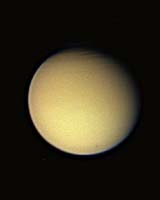
NASA Study Shows Titan And Early Earth Atmospheres Are Similar
Moffett Field CA (SPX) Nov 07, 2006 Organic haze in the atmosphere of Saturn's moon, Titan, is similar to haze in early Earth's air -- haze that may have helped nourish life on our planet-- according to a NASA Astrobiology Institute study released Nov. 6, 2006. Study scientists simulated both the atmospheric conditions of early Earth and those of present-day Titan. Their study, "Organic Haze on Titan and the Early Earth," describing the scientists' work, appears in Proceedings of the National Academy of Sciences. The principal author is Melissa Trainer, a NASA Astrobiology Institute postdoctoral fellow at the University of Colorado, Boulder. "It's exciting to see that the early Earth experiments produced so much organic matter," said Carl Pilcher, director of the NASA Astrobiology Institute, at NASA Ames Research Center, Moffett Field, Calif. "An organic haze produced this way on early Earth could have contributed to the formation and sustenance of life." According to the study's researchers, their experiments help scientists interpret observations of Titan's atmosphere from NASA's Cassini mission, while also showing how a major source of organics could have been produced on Earth billions of years ago. The researchers reported that the aerosols produced in the laboratory could serve as analogs for the observed haze in Titan's atmosphere. The scientists also estimated that aerosol production on early Earth could have served as a primary source of organic material to the surface. "This paper shows one of the ways in which the study of other worlds can help us understand Earth," said Chris McKay, a scientist at NASA Ames and one of the study's co-authors. "Titan has a thick organic haze layer, and this work started out to understand the chemistry of that alien organic haze. Then we realized that we could apply the same approach to the organic haze on early Earth." "We hope to determine how the organics were made and their chemical nature," McKay observed. The scientists reported that when sunlight hits an atmosphere of methane and nitrogen, like the atmosphere of Titan today, aerosol particles form. When an atmosphere also contains carbon dioxide, as in the atmosphere of ancient Earth, different kinds of aerosols form. The scientists used a special ultraviolet-light lamp to produce particles in the simulated atmospheres, and measured the chemical composition, size and shape of the resulting particles. "It's somewhat similar to the smog in Los Angeles," Trainer explained. "Today's haze on Earth is also created photochemically, which means sunlight powers chemical reactions in the atmosphere. However, the early atmosphere of Earth had different gases present, so chemical composition of the early haze is very different than the haze we have today. There also would have been a lot more of it." Community Email This Article Comment On This Article Related Links University of Colorado, Boulder Explore The Ring World of Saturn and her moons Explore The Ring World of Saturn and her moons Jupiter and its Moons The million outer planets of a star called Sol News Flash at Mercury
 The Lone Pale Blue Dot As Seen By Cassini
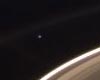 Pasadena (SPX) Nov 03, 2006
A recent photo from the Cassini spacecraft shows the mighty planet Saturn, and if you look very closely between its wing-like rings, a faint pinprick of light. That tiny dot is Earth bustling with life as we know it. The image is the second ever taken of our world from deep space. The first, captured by the Voyager spacecraft in 1990, stunned many people, including the famous astronomer Carl Sagan who called our seemingly miniscule planet a "pale blue dot" and "the only home we've ever known." |
|
|

| The content herein, unless otherwise known to be public domain, are Copyright 1995-2006 - SpaceDaily.AFP and UPI Wire Stories are copyright Agence France-Presse and United Press International. ESA PortalReports are copyright European Space Agency. All NASA sourced material is public domain. Additionalcopyrights may apply in whole or part to other bona fide parties. Advertising does not imply endorsement,agreement or approval of any opinions, statements or information provided by SpaceDaily on any Web page published or hosted by SpaceDaily. Privacy Statement |