|
 |
 |
 |
 |
 |
 |
 |
 |

 |
NASA Study Reveals Less Water In Clouds Of Mars
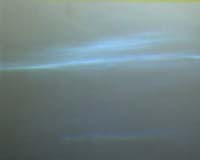
Moffett Field CA (SPX) Dec 07, 2007 Martian clouds may contain less water than previously thought, according to a new NASA study. New NASA laboratory measurements of simulated martian clouds reveal that scientists may have been overestimating the amount of water in the planet's atmosphere. "The martian clouds we are studying are composed of water ice, like some clouds on Earth. However, they are forming at very cold temperatures, often below minus 100 degrees Celsius (minus 212 degrees Fahrenheit)," said Tony Colaprete, a planetary scientist at NASA's Ames Research Center, Moffett Field, Calif. "What we have found in our laboratory studies is that it is much harder to initiate cloud formation at these cloud temperatures than what we thought," he explained. "This difficulty results in larger cloud particles, which fall out of the atmosphere more quickly and, thus, result in less cloud mass and a drier atmosphere," Colaprete explained. Colaprete will present his findings on at 1:40 p.m. PST Tuesday, Dec. 11, 2007, during the annual American Geophysical Union (AGU) fall meeting at San Francisco's Moscone Convention Center South in Exhibit Hall B. Previously, scientists believed that martian clouds would form at 100 percent relative humidity, but the new study shows that martian air has to be more supersaturated with water to form clouds than scientists theorized before. "We want to understand the climate of Mars and how the martian water cycle operates," Colaprete said. "Clouds are integral to this system, just as on Earth. However, assuming the clouds form or behave the same as on Earth, may be a bad assumption." According to Colaprete, more accurate understanding of the processes that control martian clouds and water cycle are critical to understanding Mars' current and past climates. A large water ice cap at the martian north pole dominates the martian water cycle. During the northern summer, this water ice cap evaporates, and winds carry the resulting water vapor to the south pole, according to Colaprete. "The amount of water in the martian atmosphere varies greatly in space and time," Colaprete observed. Clouds in the atmosphere largely control the amount of water that comes off of the north pole and migrates to the south pole. "Water that reaches the southern winter pole freezes to the surface," Colaprete said. "In the southern spring, this water re-evaporates and returns to the northern polar cap. The cycle is repeated year after year." If all the water in the atmosphere were to freeze out to the surface, it would make a layer of ice about one-fifth the thickness of a human hair, according to Colaprete. "Cloud mass is typically only 10 to 20 percent of the total water content. However, the thin martian atmosphere is much more sensitive/reactive to the influence of these clouds," he said. Community Email This Article Comment On This Article Related Links Mars News and Information at MarsDaily.com Lunar Dreams and more
 Spirit Breaks Free In Race For Survival
 Pasadena CA (JPL) Dec 04, 2007
In typical unflagging fashion, Spirit has managed to break free of piles of soil built up around the wheels in a low, sandy area that the rover's handlers have nicknamed "Tartarus," after a deep, underworld dungeon in Greek mythology. Team members are pulling out all the stops to get Spirit to a winter location where, based on solar power projections, the rover has a chance at survival. |
|
|

| The content herein, unless otherwise known to be public domain, are Copyright 1995-2007 - SpaceDaily.AFP and UPI Wire Stories are copyright Agence France-Presse and United Press International. ESA Portal Reports are copyright European Space Agency. All NASA sourced material is public domain. Additional copyrights may apply in whole or part to other bona fide parties. Advertising does not imply endorsement,agreement or approval of any opinions, statements or information provided by SpaceDaily on any Web page published or hosted by SpaceDaily. Privacy Statement |