
 |
 |
 |
 |
 |
 |
 |
 |
 |

 |
NASA Study Provides Next Step To Establishing Lunar Outpost
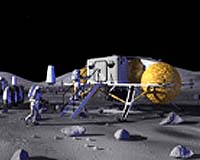
Houston TX (SPX) Jun 25, 2008 NASA engineers and scientists completed a milestone review June 20 that will help determine the systems needed to return humans to the moon and establish a lunar outpost. The three-day Lunar Capability Concept Review capped a nine-month study led by the Exploration Systems Mission Directorate at NASA Headquarters in Washington that incorporated science and exploration objectives earlier developed by representatives of 14 countries as part of the Global Exploration Strategy. The study looked at possible lunar mission scenarios and compared them to the capabilities of the emerging Ares V heavy lift launch vehicle and the Altair lunar lander design concepts. This review of those findings, led by the Constellation Program Office at NASA's Johnson Space Center in Houston, established all the technical parameters that will be needed to begin Phase A, the first phase in preparing vehicle requirements. "We confirmed that Constellation's conceptual designs for both Ares V and Altair will enable us to land astronauts and cargo anywhere on the moon and to build an outpost supporting widespread exploration of the lunar surface," said Jeff Hanley, Constellation Program manager at Johnson. "This extensive review proves we are ready for the next phase: taking these concepts and moving forward to establish mature requirements." According to Hanley, the study bears out the strength of the initial concepts showing the vehicles can be built and delivered in time to return humans to the moon by 2020. The review also reinforced the key role of international partnerships and industry collaboration to developing the lunar surface systems for human missions to the moon. Phase A begins the process of defining the vehicle and element requirements. During this phase, the Ares V and Altair Project teams will take what was learned from the Lunar Capability Concept Review and baseline the needs for lunar missions, establish the design needs and determine plans for advancing the technologies needed to be successful. Phase A will culminate in a Systems Requirements Review for NASA's lunar transportation architecture, tentatively planned for 2010. The review refined early configurations of the Ares V rocket to ensure its capability to deliver the Altair lunar lander, four astronauts and cargo anywhere on the moon and return the crew to Earth at any time. To accomplish those objectives, the current configuration of the Ares V will use six RS-68B liquid oxygen and liquid hydrogen engines on a core stage along with two five-and-one-half segment solid propellant rocket boosters, which are a direct evolution from the first stage of the Ares I rocket. The Ares V upper stage will propel the Orion crew capsule and Altair to the moon using the same J-2X engine as the Ares I crew launch vehicle. The Ares V will stand about 381 feet tall and be able to send more than 156,600 pounds of cargo and components into orbit to the moon, and later to Mars or other destinations. Altair will be capable of landing four astronauts anywhere on the moon, providing life support and a base for the first week-long surface exploration missions, and returning the crew to the Orion spacecraft for the ride home to Earth. A variant of the lunar lander will serve as an autonomous cargo carrier, taking modular outpost components, lunar rovers, and scientific equipment to the moon's surface. The formal decision to start Phase A will be taken to NASA's leaders before the end of this year. The Constellation Program Office at Johnson has the responsibility for developing the next human space transportation system that will be used to extend a human presence throughout the solar system. The program includes multiple project offices and technical teams at all ten NASA centers and at contract organizations around the nation. The Orion Project and Altair Project also are led from Johnson. The Ares Project Office at NASA's Marshall Space Flight Center in Huntsville, Ala., leads the design and development of the Ares I rocket and Ares V cargo launch vehicle. The Ground Operations Project at NASA's Kennedy Space Center in Florida will handle ground and launch operations for the vehicles. Community Email This Article Comment On This Article Share This Article With Planet Earth
Related Links NASA Constellation Program Mars News and Information at MarsDaily.com Lunar Dreams and more
 Moon-Bound NASA Spacecraft Passes Major Preflight Tests
 Moffett Field CA (SPX) Jun 25, 2008
Satellite Engineering teams are conducting final checkouts of the Lunar Crater Observation and Sensing Satellite, known as LCROSS, that will take a significant step forward in the search for water on the moon. |
|
|

| The content herein, unless otherwise known to be public domain, are Copyright 1995-2007 - SpaceDaily.AFP and UPI Wire Stories are copyright Agence France-Presse and United Press International. ESA Portal Reports are copyright European Space Agency. All NASA sourced material is public domain. Additional copyrights may apply in whole or part to other bona fide parties. Advertising does not imply endorsement,agreement or approval of any opinions, statements or information provided by SpaceDaily on any Web page published or hosted by SpaceDaily. Privacy Statement |
 del.icio.us
 Digg
Digg Reddit
 YahooMyWeb
 Google
 Facebook