Energy News  
NASA Study Links Smog To Arctic Warming

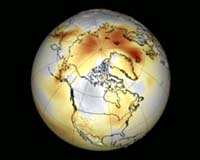
Tropospheric ozone was responsible for one-third to half of the observed warming trend in the Arctic during winter and spring, according to the research at GISS. Ozone is transported from the industrialized countries in the Northern Hemisphere to the Arctic quite efficiently during these seasons.
by Staff Writers
Greenbelt MD (SPX) Mar 15, 2006
Scientists have found that a major form of global air pollution involved in summertime "smog" has also played a significant role in warming the Arctic. In a global assessment of the impact of ozone on climate warming, NASA scientists at the Goddard Institute for Space Studies, evaluated how ozone in the lowest part of the atmosphere changed temperatures over the past 100 years.

Using the best available estimates of global emissions of gases that produce ozone, the GISS computer model study reveals how much this single air pollutant, and greenhouse gas, has contributed to warming in specific regions of the world.

According to this new research, ozone was responsible for one-third to half of the observed warming trend in the Arctic during winter and spring. Ozone is transported from the industrialized countries in the Northern Hemisphere to the Arctic quite efficiently during these seasons. The findings have been accepted for publication in the American Geophysical Union's Journal of Geophysical Research-Atmospheres.

Ozone plays several different roles in the Earth�s atmosphere. In the high-altitude region of the stratosphere, ozone acts to shield the planet from harmful ultraviolet radiation. In the lower portion of the atmosphere (the troposphere), ozone can damage human health, crops and ecosystems. Ozone is also a greenhouse gas and contributes to global warming.

Ozone is formed from several other chemicals found in the atmosphere near the Earth's surface that come from both natural sources and human activities such as fossil fuel burning, cement manufacturing, fertilizer application and biomass burning. Ozone is one of several air pollutants regulated in the United States by the U. S. Environmental Protection Agency.

The impact of ozone air pollution on climate warming is difficult to pinpoint because, unlike other greenhouse gases such as carbon dioxide, ozone does not last long enough in the lower atmosphere to spread uniformly around the globe.

Its warming impact is much more closely tied to the region it originated from. To capture this complex picture, GISS scientists used a suite of three-dimensional computer models that starts with data on ozone sources and then tracks how ozone chemically evolved and moved around the world over the past century.

The warming impact of low-altitude ozone on the Arctic is very small in the summer months because ozone from other parts of the globe does not have time to reach the region before it is destroyed by chemical reactions fueled by ample sunshine. As a result, when it is summertime in the Northern Hemisphere, ozone-induced warming is largest near the sources of ozone emissions.

The computer model showed large summer warming from ozone over western North America and eastern Europe/central Asia, areas with high levels of ozone pollution during that time of year.

The new results identify an unexpected benefit of air pollution control efforts worldwide, according to lead author Drew Shindell. "We now see that reducing ozone pollution can not only improve air quality but also have the added benefit of easing climate warming, especially in the Arctic."
Community
Email This Article
Comment On This Article

Related Links
NASA Goddard Institute for Space Studies
Our Polluted World and Cleaning It Up


Memory Foam Mattress Review
Newsletters :: SpaceDaily :: SpaceWar :: TerraDaily :: Energy Daily
XML Feeds :: Space News :: Earth News :: War News :: Solar Energy News


Worst Ever Oil Spill In Alaska North Slope
Los Angeles (AFP) Mar 15, 2006
Up to one million liters (267,000 gallons) of oil have leaked from a damaged pipeline in Alaska's North Slope, the worst spill in the region's history, authorities said Tuesday.


  • Price Of Processing Ultra-Clean Coal Gets Economical
  • Energy-Efficient Housing: Project Debuts Air-Handling System
  • CSIRO Builds Smart Energy System
  • Combination Of Processes Results In Cleaner Petrol

  • Nuclear Technology Could Power India To The Top
  • Problems persist 20 years after Chernobyl
  • Russia Revives International Nuclear Waste Depot Plan
  • Baltic Prime Ministers Back Construction Of New Nuclear Plant

  • NASA Studies Air Pollution Flowing Into US From Abroad
  • Carbon Balance Killed The Dinos
  • Earth's Turbulence Stirs Things Up Slower Than Expected
  • Advanced Aircraft to Probe Hazardous Atmospheric Whirlwinds

  • Palm Oil: Enemy Number One Of Indonesia's Tropical Rainforests
  • Corruption Destroying Largest Asia-Pacific Forest
  • Saving Tropical Forests: Will Europe's "Jack" fell Asia's "Giant"
  • Researchers, Others To Explore Nanotechnology And Forest Products

  • Setting The Agenda For Food Security In Europe
  • Robots And Inflatable Conveyor Belts Set To Slash Farm Labour Costs
  • New Study Confirms The Ecological Virtues Of Organic Farming
  • Japanese Researchers Extract Vanilla From Cow Dung

  • Research On The Road To Intelligent Cars
  • Volvo Promises Hybrid Truck Engines Within Three Years
  • Carbon Fiber Cars Could Put US On Highway To Efficiency
  • Ventilated Auto Seats Improve Fuel Economy, Comfort

  • Lockheed Martin Delivers F-22 Raptor To Second Operational Squadron
  • CAESAR Triumphs As New Gen Of Radar Takes Flight
  • Northrop Grumman to Provide F-16 Fleet To Greek Air Force
  • US Offers India Advanced Fighter Aircraft

  • Could NASA Get To Pluto Faster? Space Expert Says Yes - By Thinking Nuclear
  • NASA plans to send new robot to Jupiter
  • Los Alamos Hopes To Lead New Era Of Nuclear Space Tranportion With Jovian Mission
  • Boeing Selects Leader for Nuclear Space Systems Program

  • The content herein, unless otherwise known to be public domain, are Copyright 1995-2006 - SpaceDaily.AFP and UPI Wire Stories are copyright Agence France-Presse and United Press International. ESA PortalReports are copyright European Space Agency. All NASA sourced material is public domain. Additionalcopyrights may apply in whole or part to other bona fide parties. Advertising does not imply endorsement,agreement or approval of any opinions, statements or information provided by SpaceDaily on any Web page published or hosted by SpaceDaily. Privacy Statement