|
 |
 |
 |
 |
 |
 |
 |
 |

 |
NASA Studies New Booster
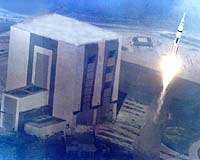
Washington (UPI) - Mar 02, 2004 NASA has begun studies to determine if it will need a new class of powerful super rockets to boost the new moon and Mars spaceships President Bush has proposed as part of a new U.S. space policy. The studies, experts told United Press International, will help shape a decision by the end of the year on the size and capabilities of the space launching vehicles that will be needed to lift payloads under Bush's plan. The decision is similar to choices that faced the National Aeronautics and Space Administration in 1962 when new rockets were proposed to lift the Apollo spacecraft and its components. The United States at the time was limited to existing families of ballistic missiles, such as Thor, Atlas and Titan, which were undergoing modifications to allow the launch of space probes instead of atomic warheads. A series of advanced rocket engines also were under development by the Air Force, however, and a family of big booster rockets, called Saturn, was being designed by the Army. Both eventually were transferred to NASA under the direction of Wernher Von Braun and became the Saturn I, IB, and a super rocket called Saturn V that carried various versions of the Apollo craft into Earth orbit and to the moon. An even larger rocket, called Nova, which could have lifted massive payloads to the moon, was studied but never built. The choice for the Apollo rocket was shaped by the decision on how to send astronauts to the moon -- the same type of decision NASA faces with Bush's space policy. Three methods were under consideration in 1962. The first would have used the huge Nova booster to send an astronaut-carrying space capsule directly from Cape Canaveral on Florida's coast to a landing on the moon's surface. The entire Apollo ship would have set down on the moon, and then the upper part with the astronauts inside the capsule would have blasted off for the return trip. A second method, called Lunar Orbit Rendezvous, would have used a single Saturn V super booster to send a lander and capsule combination first into Earth orbit and then to orbit around the moon before dispatching the lander to the surface. A third idea was called Earth Orbit Rendezvous. Under that plan, smaller Saturn I rockets would have launched various elements of Apollo into Earth orbit, where they would have been assembled forming a larger Moonship. The assembled craft would have then departed Earth orbit toward the moon. In the end, Lunar Orbit Rendezvous was selected as the best way to meet President John F. Kennedy's end-of-the-decade date declaration for the Apollo landings. Early signs indicate some version of Earth Orbit Rendezvous might be selected for Bush's Project Constellation program. Existing U.S. space boosters large enough to lift the Constellation manned capsules are the Boeing Delta IV heavy and the Lockheed Martin Atlas V heavy. Both rockets, in their largest versions, can lift about 50,000 pounds into a low Earth orbit. The Apollo capsule in the 1960s and its service unit weighed about 30,000 pounds but for the other elements of the Constellation plan, such as landing vehicles, surface equipment, and shelters for astronauts, heavy lifting rockets likely will be needed. The Apollo Saturn V could insert 250,000 pounds into low orbit and dispatch 100,000 pounds to the moon. No rocket in the U.S. arsenal is capable of lifting such large weights into space today. To meet the need, and to keep costs low, space planners are looking closely at an unmanned version of the space shuttle. Replacing the winged shuttle orbiter with a cargo unit, such a vehicle could lift 100,00 pounds or more into orbit while still using the launching facilities, hangars and trained workforce now employed in the piloted shuttles. Several versions of a shuttle cargo ship are being studied by NASA and its industry teams. One version would convert the Boeing-built winged orbiters Atlantis, Discovery and Endeavour into robot ships that do not carry people. With the life support and other human-sustaining equipment removed, the converted shuttlecraft would carry an additional 25,000 pounds or more than the current limit of 55,000 pounds. The robotic shuttles also would be capable of carrying the current craft's robot arm for moving cargo about, and docking with the International Space Station. Other design versions would continue to fly the shuttle's Lockheed external fuel tank and ATK-Thiokol-made solid booster rockets but would add an additional segment to the boosters, increasing their lifting power. In place of the orbiters, designers are looking at different shapes and sizes of cargo pods. Some would use the current cluster of the orbiter's three liquid engines in its tail, which would separate and be recovered at sea in a small capsule. Another idea would be to replace the orbiter's liquid engines under the proposed payload pod with engines now flown on the Deltas or Atlases. These more powerful engines could boost the craft's lifting ability to 200,000 pounds or more. As space planners move through their design studies, it would appear that some combination of Delta, Atlas and Shuttle-evolved heavy cargo rockets will be the rocketships that power Bush's moon and Mars dreams. All rights reserved. Copyright 2004 by United Press International. Sections of the information displayed on this page (dispatches, photographs, logos) are protected by intellectual property rights owned by United Press International. As a consequence, you may not copy, reproduce, modify, transmit, publish, display or in any way commercially exploit any of the content of this section without the prior written consent of by United Press International. Community Email This Article Comment On This Article Related Links SpaceDaily Search SpaceDaily Subscribe To SpaceDaily Express Rocket Science News at Space-Travel.Com
 Successful First Test For Vega's Zefiro 9 Engine
 Paris, France(ESA) Dec 28, 2005
Flames, smoke and a deafening noise accompanied the first firing test of Vega's Zefiro 9 third-stage solid rocket motor. A first examination of the data indicates that everything went well at the test carried out yesterday at Salto de Quirra in southeast Sardinia. |
|
|

| The content herein, unless otherwise known to be public domain, are Copyright 1995-2006 - SpaceDaily.AFP and UPI Wire Stories are copyright Agence France-Presse and United Press International. ESA PortalReports are copyright European Space Agency. All NASA sourced material is public domain. Additionalcopyrights may apply in whole or part to other bona fide parties. Advertising does not imply endorsement,agreement or approval of any opinions, statements or information provided by SpaceDaily on any Web page published or hosted by SpaceDaily. Privacy Statement |