|
 |
 |
 |
 |
 |
 |
 |
 |

 |
NASA Spacecraft To Carry Russian Science Instruments
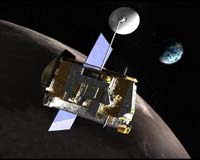
Washington DC (SPX) Oct 10, 2007 NASA and the Russian Federal Space Agency Roscosmos have agreed to fly two Russian scientific instruments on NASA spacecraft that will conduct unprecedented robotic missions to the moon and Mars. NASA Administrator Michael Griffin and Roscosmos head Anatoly Perminov signed agreements in Moscow on Oct. 3 to add the instruments to two future missions: the Lunar Reconnaissance Orbiter, scheduled to launch in October 2008, and the Mars Science Laboratory, an advanced robotic rover scheduled to launch in 2009. Russia's Lunar Exploration Neutron Detector on the Lunar Reconnaissance Orbiter will search for evidence of water ice and help understand astronauts' exposure to radiation during future trips to the moon. The instrument will map concentrations of hydrogen that may be found on and just beneath the lunar surface. Roscosmos' Dynamic Albedo of Neutrons instrument on the Mars Science Laboratory will measure hydrogen to analyze neutrons interacting with the Martian surface. The principal investigator for both instruments is Igor Mitrofanov of the Institute for Space Research of the Russian Academy of Science. "Russia's contribution to the Lunar Reconnaissance Orbiter and Mars Science Laboratory missions continues a rich and long-standing tradition of cooperation between NASA and Russia for scientific research in space," Griffin said. "The Institute for Space Research has a track record of delivering excellent instrumentation, and we are delighted to have international participation on these missions to explore the moon and send a robotic laboratory to Mars." The Lunar Reconnaissance Orbiter will circle the moon for at least a year, obtaining measurements necessary to identify future robotic and human landing sites. It also will look for potential lunar resources and document aspects of the lunar radiation environment. The Mars Science Laboratory rover is a mobile research platform that will explore a local region of the Martian surface as a potential habitat for past or present life. The rover will carry a suite of highly capable analytic and remote sensing instruments to investigate planetary processes that influence habitability, including the role of water. Community Email This Article Comment On This Article Related Links The latest information about the Commercial Satellite Industry
 Orbital-Built Intelsat-11 And Optus D2 Communications Satellites Successfully Launched
 Dulles VA (SPX) Oct 09, 2007
Orbital Sciences , the world leader in smaller-sized geosynchronous (GEO) communications satellites, announced that two of its satellites were successfully launched into orbit during a mission that took place on Friday, October 5. The two satellites, Intelsat-11 (IS-11) and Optus D2, were delivered into their initial orbit by an Ariane 5 rocket launched from the European space launch complex located near the Equator in French Guiana. Results from early tests of the spacecraft conducted over the weekend indicate that both satellites are operating as planned for this phase of their missions. |
|
|

| The content herein, unless otherwise known to be public domain, are Copyright 1995-2007 - SpaceDaily.AFP and UPI Wire Stories are copyright Agence France-Presse and United Press International. ESA Portal Reports are copyright European Space Agency. All NASA sourced material is public domain. Additional copyrights may apply in whole or part to other bona fide parties. Advertising does not imply endorsement,agreement or approval of any opinions, statements or information provided by SpaceDaily on any Web page published or hosted by SpaceDaily. Privacy Statement |