|
 |
 |
 |
 |
 |
 |
 |
 |

 |
NASA Spacecraft Set To Catch Some Rays
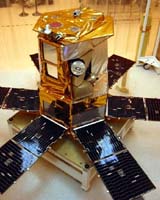
Greenbelt - Jan 24, 2003 A new NASA satellite is ready to leave the sandy coast of Florida and head to space to catch some rays. The SORCE (Solar Radiation and Climate Experiment) mission will study our sun's influence on our planet's climate by measuring how the star affects the Earth's ozone layer, atmospheric circulation, clouds, and oceans. The research data that will help us to better protect and understand our home planet. SORCE is scheduled to launch from off the coast of the Kennedy Space Center, Fla., on January 25 aboard a Pegasus XL launch vehicle at approximately 3:14 p.m. EST. The Pegasus XL rocket is dropped from the wing of an L-1011 aircraft over the Atlantic Ocean. After falling a few seconds, the spacecraft's engines will power on and lift it into orbit. The satellite will orbit at an altitude of 397.8 miles (640 kilometers). "This mission will help to distinguish between natural and human-induced influences in climate change. Incoming light energy from the sun is ultimately what powers our climate system. Past NASA missions showed the amount of solar radiation is not constant, but rather varies over time. SORCE will help us understand these variations, and the role of solar variability in climate change," said Dr. Ghassem Asrar, NASA's Associate Administrator for Earth Science. SORCE is a small free-flying satellite carrying four scientific instruments to measure the solar radiation at the top of the Earth's atmosphere and how the sun influences Earth's atmosphere and climate. The four instruments on SORCE are the Total Irradiance Monitor, the Spectral Irradiance Monitor, Solar Stellar Irradiance Comparison Experiment, and the Extreme Ultraviolet Photometer System. The first three will measure solar irradiance and the solar spectrum to help scientists understand the sun's role in climate change. The Photometer System will measure high-energy radiation from the sun. "We are very excited as we near our launch date." said Bill Ochs, SORCE Project Manager at NASA's Goddard Space Flight Center (GSFC) in Greenbelt, Md. "This mission has been a tremendous team effort between the University of Colorado, NASA, and Orbital Sciences Corporation," he said. This mission is a joint partnership between NASA and the University of Colorado's Laboratory for Atmospheric and Space Physics (LASP) in Boulder. SORCE is a principal investigator- led mission with GSFC providing management, scientific oversight and engineering support. Scientists and engineers at LASP designed, built, calibrated, and tested the four science instruments on SORCE. LASP subcontracted with Orbital Sciences Corporation for the spacecraft and observatory integration and testing. The Mission Operations Center and the Science Operations Center are both operated at LASP. LASP will operate the spacecraft over its five-year mission life and is responsible for the acquisition, management, processing, and distribution of the science data. SORCE data will support studies in long-term climate change, natural variability, enhanced climate prediction, and atmospheric ozone and UV-B radiation. The SORCE measurements are critical to studies of the variability of the sun; its effect on our Earth system; and its influence on humankind. SORCE is a part of NASA's Earth Science Enterprise, a program dedicated to understanding the Earth as an integrated system and applying Earth system science to improve prediction of climate, weather, and natural hazards using the vantage point of space. Community Email This Article Comment On This Article Related Links Sorce at Colorado Sorce at Goddard SpaceDaily Search SpaceDaily Subscribe To SpaceDaily Express Solar Science News at SpaceDaily
 From 'Macro' To 'Micro' � Turbulence Seen By Cluster
 Paris (ESA) Aug 11, 2005
Thanks to measurements by ESA's Cluster mission, a team of European scientists have identified 'micro'-vortices in Earth's magnetosphere. |
|
|

| The content herein, unless otherwise known to be public domain, are Copyright 1995-2006 - SpaceDaily.AFP and UPI Wire Stories are copyright Agence France-Presse and United Press International. ESA PortalReports are copyright European Space Agency. All NASA sourced material is public domain. Additionalcopyrights may apply in whole or part to other bona fide parties. Advertising does not imply endorsement,agreement or approval of any opinions, statements or information provided by SpaceDaily on any Web page published or hosted by SpaceDaily. Privacy Statement |