|
 |
 |
 |
 |
 |
 |
 |
 |

 |
NASA Spacecraft Detects Volcanic Activity In Antarctica
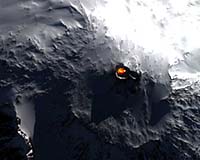
Greenbelt (SPX) Jun 28, 2004 Antarctica, the coldest place on Earth, is also home to volcanic fire. Looming above the frigid sea is Mount Erebus, a volcano that has erupted frequently over the last 200 years. For the first time, software on a NASA spacecraft has discovered a new eruption on Erebus and reprogrammed the spacecraft for a repeat observation without human input. The Space Technology 6 Autonomous Sciencecraft Experiment, recently developed by NASA's Jet Propulsion Laboratory, Pasadena, California and integrated on-board the Earth Observing-1 spacecraft at NASA's Goddard Space Flight Center in Greenbelt, Maryland is being employed for volcano and other hazard monitoring activities. The software examines image data from the Hyperion spectrometer, a hyperspectral instrument highly sensitive to heat released from molten lava. After taking an image of Erebus, the software detected heat from the lava lake at the summit of the volcano and rescheduled the spacecraft to acquire additional images within hours. News of the detection was rapidly transmitted to scientists as well as data from the two observations. "Normally, it would take weeks to learn that a remote volcano was active." said Stu Frye, the Earth Observing-1 System Engineer at Goddard." But, now we can gather multiple images of the eruption's progression before news of the event becomes widely known". "Autonomous Sciencecraft is a giant leap toward a thinking spaceship." said Dr. Steve Chien, JPL's senior technologist for the software. The software is the first use of autonomy allowing the spacecraft to make decisions without waiting for command from scientists. It can capture short-lived science events that otherwise would have been missed." Researchers at JPL and Goddard are testing the Autonomous Sciencecraft Experiment on Erebus and other volcanoes around the world for the next several months. "With this software, we can now monitor many more volcanoes because it knows how to only look at active volcanic sites," said Dr. Ashley Davies, JPL lead scientist for the experiment. "We can focus on important eruptions and obtain a lot more imagery over the duration of the eruption." "Presently we are extending the Autonomous Sciencecraft Experiment by setting up the software to autonomously monitor over 50 known volcano sites for activity." said Dan Mandl, the Earth Observing-1 Mission Director at Goddard. Future versions may be used to track dust storms on Mars, search for ice volcanoes on Europa, monitor activity on Jupiter's volcanically active moon Io. NASA's New Millennium Program developed both the satellite and the software, and is responsible for testing new technologies in space. Community Email This Article Comment On This Article Related Links Autonomous Sciencecraft Experiment Earth Observing-1 SpaceDaily Search SpaceDaily Subscribe To SpaceDaily Express Nuclear Space Technology at Space-Travel.com
 Rewriting Glacial History In Pacific North America
 Edmonton AB (SPX) Jan 10, 2006
Although the story on glacier fluctuations in northwestern North America over the last 10,000 years has remained largely unchanged for decades, new evidence discovered by a University of Alberta researcher will rewrite that glacial history and offer clues about our climate history during the last several thousand years. |
|
|

| The content herein, unless otherwise known to be public domain, are Copyright 1995-2006 - SpaceDaily.AFP and UPI Wire Stories are copyright Agence France-Presse and United Press International. ESA PortalReports are copyright European Space Agency. All NASA sourced material is public domain. Additionalcopyrights may apply in whole or part to other bona fide parties. Advertising does not imply endorsement,agreement or approval of any opinions, statements or information provided by SpaceDaily on any Web page published or hosted by SpaceDaily. Privacy Statement |