|
 |
 |
 |
 |
 |
 |
 |
 |

 |
NASA Selects Technology Validation Experiments
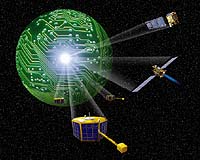
Washington DC (SPX) Jan 31, 2005 NASA has chosen four teams to develop a suite of advanced technologies slated for space flight validation on the New Millennium Programs Space Technology 8 (ST8) Mission. The ST8 Mission, slated for launch in 2008, is a New Millennium Carrier that will host a varied payload of four advanced technologies. Each technology validation experiment will include diagnostic instruments. They will perform detailed measurements to characterize and determine how well the technologies performance in space corresponds to predictions derived from ground-based testing and modeling. The resulting data will be provided to science mission planners to enable a broad range of space-based science projects at significantly reduced risk and cost. The selected suite of advanced technology experiments includes: Ultraflex Next Generation Solar Array System (NGU) from AEC-Able Engineering, Goleta, Calif. The NGU is an ultra-lightweight flexible-blanket solar array that deploys to provide a significant advancement in performance over existing state-of-the-art for high power arrays. The proposed experiment cost for the NGU is $6.9 million. SAILMAST Ultra Lightweight Boom from AEC-Able Engineering. The SAILMAST is an ultra-light graphite mast intended for solar sail propulsion systems. The proposed experiment cost for the SAILMAST is $4 million. Miniature Loop Heat Pipe Small Spacecraft Thermal Management System (MLHP) from NASA's Goddard Space Flight Center, Greenbelt, Md. The MLHP can transport large heat loads over long distances with small temperature differences and without external pumping powers to provide precise temperature control and reduce the need for supplemental heaters. The proposed experiment cost for the MLHP is $9.8 million. Environmentally Adaptive Fault Tolerant Computing System (EAFTC) from Honeywell International, Clearwater, Fla. The EAFTC will provide high rate on board processing for science data and autonomous control functions. The proposed experiment cost for the EAFTC is $10 million. "These technological capabilities will provide orders of magnitude in performance compared to the state-of-the-art technologies used in NASA satellites," said NASA's Deputy Associate Administrator of the Science Mission Directorate, Dr. Ghassem Asrar. "Future NASA science and exploration missions will benefit greatly from these technological capabilities, which will be developed for first flight validation. The ST8 project will effectively develop these technologies from the early stages to flight readiness, and then validate them in space prior to using them in NASA sponsored scientific missions," he said. NASA's New Millennium Program plans to invest approximately $40 million to develop and flight-validate the selected technology experiments. The total project cost for formulation and implementation, including technology payloads, the carrier spacecraft and the launch vehicle, is planned at $100 million. The Programs' previous technology validation missions included Deep Space 1, Deep Space 2 and Earth Observing 1. The programs validated a broad range of advanced technologies including ion propulsion, autonomous onboard mission planning, and advanced land-imaging instruments. Current projects include: Space Technology 5, a mission to validate next generation constellations of micro-satellites; Space Technology 6, which is developing both an autonomous onboard science and mission planning system and an advanced inertial stellar compass; and Space Technology 7, which is developing the precision sensing and control systems required for future gravity wave science. The four technology teams for the ST8 flight validation opportunity were selected from 37 proposers responding to a NASA Research Announcement (NRA) in February, 2003. As a result of the NRA, 10 teams were awarded contracts for a six-month concept definition study phase. Study phase results were evaluated by a NASA-led independent peer review, which culminated in the selection of the four teams for continuation to the formulation refinement and implementation phases. NASA's Jet Propulsion Laboratory, Pasadena, Calif., manages the New Millennium Program for the Science Mission Directorate. Community Email This Article Comment On This Article Related Links NASA's New Millenium Program SpaceDaily Search SpaceDaily Subscribe To SpaceDaily Express Rocket Science News at Space-Travel.Com
 Successful First Test For Vega's Zefiro 9 Engine
 Paris, France(ESA) Dec 28, 2005
Flames, smoke and a deafening noise accompanied the first firing test of Vega's Zefiro 9 third-stage solid rocket motor. A first examination of the data indicates that everything went well at the test carried out yesterday at Salto de Quirra in southeast Sardinia. |
|
|

| The content herein, unless otherwise known to be public domain, are Copyright 1995-2006 - SpaceDaily.AFP and UPI Wire Stories are copyright Agence France-Presse and United Press International. ESA PortalReports are copyright European Space Agency. All NASA sourced material is public domain. Additionalcopyrights may apply in whole or part to other bona fide parties. Advertising does not imply endorsement,agreement or approval of any opinions, statements or information provided by SpaceDaily on any Web page published or hosted by SpaceDaily. Privacy Statement |