|
 |
 |
 |
 |
 |
 |
 |
 |

 |
NASA Selects Orion Crew Exploration Vehicle Prime Contractor
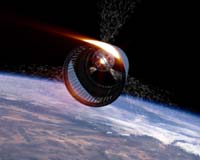
Houston TX (SPX) Aug 31, 2006 NASA selected Thursday Lockheed Martin as the prime contractor to design, develop, and build Orion, America's spacecraft for a new generation of explorers. Orion will be capable of transporting four crewmembers for lunar missions and later supporting crew transfers for Mars missions. Orion could also carry up to six crew members to and from the International Space Station. The first Orion launch with humans onboard is planned for no later than 2014, and for a human moon landing no later than 2020. Orion will form a key element of extending a sustained human presence beyond low-Earth orbit to advance commerce, science and national leadership. The contract with Lockheed Martin is the conclusion of a two-phase selection process. NASA began working with the two contractor teams, Northrop Grumman/Boeing and Lockheed Martin, in July 2005 to perform concept refinement, trade studies, analysis of requirements and preliminary design options. Lockheed Martin will be responsible for the design, development, testing, and evaluation (DDT and E) of the new spacecraft. Manufacturing and integration of the vehicle components will take place at contractor facilities across the country. Lockheed Martin will perform the majority of the Orion vehicle engineering work at NASA's Johnson Space Center, Houston, and complete final assembly of the vehicle at the Kennedy Space Center, Fla. All 10 NASA centers will provide technical and engineering support to the Orion project. The contract is structured into separate schedules for DDT and E with options for production of additional spacecraft and sustaining engineering. During DDT and E, NASA will use an end-item cost-plus-award-fee incentive contract. This makes the award fee subject to final determination after the contractor has demonstrated that it meets the technical, cost, and schedule requirements of the contract. DDT and E work is estimated to occur from Sept. 8, 2006, through Sept. 7, 2013. The estimated value is $3.9 billion. Production and sustaining engineering activities are contract options that will allow NASA to obtain additional vehicles as needed. Delivery orders over and above those in the DDT and E portion will specify the number of spacecraft to be produced and the schedule on which they should be delivered. Post-development spacecraft delivery orders may begin as early as Sept. 8, 2009, through Sept. 7, 2019, if all options are exercised. The estimated value of these orders is negotiated based on future manifest requirements and knowledge gained through the DDT and E process and is estimated not to exceed $3.5 billion. Sustaining engineering work will be assigned through task orders. The work is expected to occur from Sept. 8, 2009, through Sept. 7, 2019, with an estimated value of $750 million, if all options are exercised. Community Email This Article Comment On This Article Related Links Orion at NASA Lunar Dreams and more Rocket Science News at Space-Travel.Com Rocket Science News at Space-Travel.Com
 SPACEHAB To Support Commercial Orbital Transportation Partners
 Houston TX (SPX) Aug 30, 2006
With NASA's announcement on August 18 of SpaceX and Rocketplane-Kistler as its funded partners under the Commercial Orbital Transportation Services (COTS) program, the era of commercial space has taken a bold new step. |
|
|

| The content herein, unless otherwise known to be public domain, are Copyright 1995-2006 - SpaceDaily.AFP and UPI Wire Stories are copyright Agence France-Presse and United Press International. ESA PortalReports are copyright European Space Agency. All NASA sourced material is public domain. Additionalcopyrights may apply in whole or part to other bona fide parties. Advertising does not imply endorsement,agreement or approval of any opinions, statements or information provided by SpaceDaily on any Web page published or hosted by SpaceDaily. Privacy Statement |