|
 |
 |
 |
 |
 |
 |
 |
 |

 |
NASA Selects New Frontiers Mission Concept Study
Pasadena CA (JPL) Jun 01, 2005 NASA announced Wednesday that a mission to fly to Jupiter will proceed to a preliminary design phase. The mission is called Juno, and it is the second in NASA's New Frontiers Program. The mission will conduct a first-time, in-depth study of the giant planet. This mission proposes to place a spacecraft in a polar orbit around Jupiter to investigate the existence of an ice-rock core; determine the amount of global water and ammonia present in the atmosphere; study convection and deep wind profiles in the atmosphere; investigate the origin of the Jovian magnetic field; and explore the polar magnetosphere. "We are excited at the prospect of the new scientific understanding and discoveries by Juno in our continued exploration of the outer reaches of our solar system during the next decade," said Dr. Ghassem Asrar, deputy associate administrator for NASA's Science Mission Directorate. At the end of the preliminary design study, the mission must pass a confirmation review that will address significant schedule, technical and cost risks before being confirmed for the development phase. Dr. Scott Bolton of Southwest Research Institute, Boulder, Colo., is the Principal Investigator. NASA's Jet Propulsion Laboratory will provide mission project management. Lockheed Martin Space Systems in Denver will build the spacecraft. NASA selected two proposed mission concepts for study in July 2004 from seven submitted in February 2004 in response to an agency Announcement of Opportunity. "This was a very tough decision given the exciting and innovative nature of the two missions," Asrar added." The selected New Frontiers science mission must be ready for launch no later than June 30, 2010, within a mission cost cap of $700 million. The New Frontiers Program is designed to provide opportunities to conduct several of the medium-class missions identified as top priority objectives in the Decadal Solar System Exploration Survey, conducted by the Space Studies Board of the National Research Council. The first NASA New Frontiers mission will fly by the Pluto-Charon system in 2014 and then target another Kuiper asteroid belt object. Community Email This Article Comment On This Article Related Links NASA's New Frontiers Program SpaceDaily Search SpaceDaily Subscribe To SpaceDaily Express Jupiter and its Moons Explore The Ring World of Saturn and her moons The million outer planets of a star called Sol News Flash at Mercury
 University Of Alberta Scientist Offers Clues To Windy Jupiter
 Edmonton AB (SPX) Nov 14, 2005
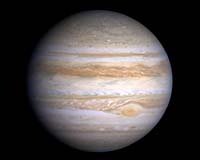
Look closely at a giant planet like Jupiter and you can actually see a powerful system of winds at work right on the surface. |
|
|

| The content herein, unless otherwise known to be public domain, are Copyright 1995-2006 - SpaceDaily.AFP and UPI Wire Stories are copyright Agence France-Presse and United Press International. ESA PortalReports are copyright European Space Agency. All NASA sourced material is public domain. Additionalcopyrights may apply in whole or part to other bona fide parties. Advertising does not imply endorsement,agreement or approval of any opinions, statements or information provided by SpaceDaily on any Web page published or hosted by SpaceDaily. Privacy Statement |