|
 |
 |
 |
 |
 |
 |
 |
 |

 |
NASA Scientists Use Radar To Detect Asteroid Force
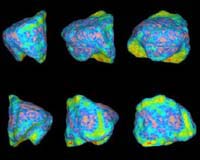
Pasadena - Dec 08, 2003 NASA scientists have for the first time detected a tiny but theoretically important force acting on asteroids by measuring an extremely subtle change in a near-Earth asteroid's orbital path. This force, called the Yarkovsky Effect, is produced by the way an asteroid absorbs energy from the sun and re-radiates it into space as heat. The research will impact how scientists understand and track asteroids in the future. Asteroid 6489 "Golevka" is relatively inconspicuous by near-Earth asteroid standards. It is only one half-kilometer (.33 mile) across, although it weighs in at about 210 billion kilograms (460 billion pounds). But as unremarkable as Golevka is on a celestial scale it is also relatively well characterized, having been observed via radar in 1991, 1995, 1999 and this past May. An international team of astronomers, including researchers from NASA's Jet Propulsion Laboratory in Pasadena, Calif., have used this comprehensive data set to make a detailed analysis of the asteroid's orbital path. The team's report appears in the December 5 issue of "Science." "For the first time we have proven that asteroids can literally propel themselves through space, albeit very slowly," said Dr. Steven Chesley, a scientist at NASA's Jet Propulsion Laboratory and leader of the study. The idea behind the Yarkovsky Effect is the simple notion that an asteroid's surface is heated by the sun during the day and then cools off during the night. Because of this the asteroid tends to emit more heat from its afternoon side, just as the evening twilight on Earth is warmer than the morning twilight. This unbalanced thermal radiation produces a tiny acceleration that has until now gone unmeasured. "The amount of force exerted by the Yarkovsky Effect, about an ounce in the case of Golevka, is incredibly small, especially considering the asteroid's overall mass," said Chesley. "But over the 12 years that Golevka has been observed, that small force has caused a shift of 15 kilometers (9.4 miles). Apply that same force over tens of millions of years and it can have a huge effect on an asteroid's orbit. Asteroids that orbit the Sun between Mars and Jupiter can actually become near-Earth asteroids." The Yarkovsky Effect has become an essential tool for understanding several aspects of asteroid dynamics. Theoreticians have used it to explain such phenomena as the rate of asteroid transport from the main belt to the inner solar system, the ages of meteorite samples, and the characteristics of so-called "asteroid families" that are formed when a larger asteroid is disrupted by collision. And yet, despite its profound theoretical significance, the force has never been detected, much less measured, for any asteroid until now. "Once a near-Earth asteroid is discovered, radar is the most powerful astronomical technique for measuring its physical characteristics and determining its exact orbit," said Dr. Steven Ostro, a JPL scientist and a contributor to the paper. "To give you an idea of just how powerful - our radar observation was like pinpointing to within a half inch the distance of a basketball in New York using a softball-sized radar dish in Los Angeles." To obtain their landmark findings, the scientists utilized an advanced model of the Yarkovsky Effect developed by Dr. David Vokrouhlick� of Charles University, Prague. Vokrouhlick� led a 2000 study that predicted the possibility of detecting the subtle force acting on Golevka during its 2003 approach to Earth. "We predicted that the acceleration should be detectable, but we were not at all certain how strong it would be," said Vokrouhlick�. "With the radar data we have been able to answer that question." Using the measurement of the Yarkovsky acceleration the team has for the first time determined the mass and density of a small solitary asteroid using ground-based observations. This opens up a whole new avenue of study for near-Earth asteroids, and it is only a matter of time before many more asteroids are "weighed" in this manner. In addition to Chesley, Ostro and Vokrouhlick�, authors of the report include Jon Giorgini, Dr. Alan Chamberlin and Dr. Lance Brenner of JPL; David Capek, Charles University, Prague, Dr. Michael Nolan, Arecibo Observatory, Puerto Rico, Dr. Jean-Luc Margot, University of California, Los Angeles, and Alice Hine, Arecibo Observatory, Puerto Rico. Community Email This Article Comment On This Article Related Links NEOs at JPL SpaceDaily Search SpaceDaily Subscribe To SpaceDaily Express Asteroid and Comet Mission News, Science and Technology
 NASA'S Spitzer Finds Possible Comet Dust Around Dead Star
 Pasadena CA (SPX) Jan 12, 2006
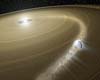
NASA's Spitzer Space Telescope has spotted what may be comet dust sprinkled around the white dwarf star G29-38, which died approximately 500 million years ago. |
|
|

| The content herein, unless otherwise known to be public domain, are Copyright 1995-2006 - SpaceDaily.AFP and UPI Wire Stories are copyright Agence France-Presse and United Press International. ESA PortalReports are copyright European Space Agency. All NASA sourced material is public domain. Additionalcopyrights may apply in whole or part to other bona fide parties. Advertising does not imply endorsement,agreement or approval of any opinions, statements or information provided by SpaceDaily on any Web page published or hosted by SpaceDaily. Privacy Statement |