|
 |
 |
 |
 |
 |
 |
 |
 |

 |
NASA Scientists Fete Bull's Eye Shot On Distant Comet
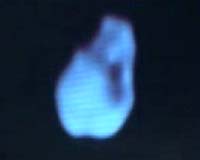
Pasadena CA (AFP) Jul 04, 2005 NASA scientists on Monday celebrated the success of the Deep Impact mission, which rammed a space probe into a comet tens of millions of miles from Earth to glean new clues about the nature of the universe. Hurtling through space at more than six miles (10 kilometers) per second, the washing machine-sized projectile crashed head-on into the Tempel 1 comet, with the collision photographed by a separate fly-by spacecraft. "What a way to kick off America's Independence Day!" Deep Impact Project manager Rick Grammier exulted about the warp speed crash, which occurred at 0552 GMT Monday. "The challenges of this mission and teamwork that went into making it a success should make us all very proud," he said. Within minutes of the crash, scientists were poring over a wealth of high-resolution images showing a bright flash of light as the projectile collided with the potato-shaped comet that was discovered in 1867. Meanwhile, the copper-laden impactor beamed back high-resolution pictures of the comet until just a few seconds before the collision. The probe rammed the heart of the Tempel 1 some 133 million kilometers (83 million miles) from Earth, a maneuver one scientist described as the "astronomical equivalent of a 767 airliner running into a mosquito." The projectile's trajectory was corrected three times in the last 90 minutes to make sure it hit the target. The fly-by spacecraft, taking photos 500 kilometers (300 miles) from the impact, was in "great shape" and filled with data that was being downlinked to the science team, Grammier said. "It's performing like a champion," he said. Initial photos showed craters, ridges and presumed glaciers on the comet, and a massive post-impact dust cloud which scientists believe could contain particles from the comet nucleus. Scientists said preliminary data showed that the impact provoked two successive flashes, which could mean the comet's surface and depth are composed of two different matters. "What you see is something really surprising. First, there is a small flash, then there's a delay, then there's a big flash and the whole thing breaks loose. We may have been able to detect some structural response to the impact," mission co-investigator Pete Shultz, of Brown University. One image shows a "self-luminous" and "extremely bright incandescent ball," he said in a news conference at NASA's Jet Propulsion Laboratory in Pasadena, California. Scientists say the comets circling the sun, which number in the billions, are leftovers from a massive cloud of gas and dust that condensed to form the Sun and planets about 4.6 billion years ago. Their geological and chemical structures could thus contain important clues to the nature of the Universe and how it was formed, including Earth. The projectile was fired from a mothership spacecraft, "Deep Impact," that was itself launched from the Kennedy Space Center in Florida in January for the 173-day, 431-million-kilometer journey. The impact gouged a football stadium-sized crater on the surface of the comet, sending up a cloud of ice, dust and debris that researchers hope will offer several years' worth of valuable scientific data. On Saturday, Tempel 1 belched out ice and dust, expanding the size of the cloud around it. The outburst, the fourth in the past three weeks, was not of particular concern to National Aeronautics and Space Administration scientists, Grammier said before the impact. "The comet is definitely full of surprises so far and probably has a few more in store for us," he said. Community Email This Article Comment On This Article Related Links Deep Impact at NASA SpaceDaily Search SpaceDaily Subscribe To SpaceDaily Express Asteroid and Comet Impact Danger To Earth - News and Science
 Hubble Captures Deep Impact's Collision With A Comet
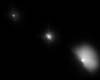 Baltimore MD (SPX) Jul 05, 2005
The NASA/ESA Hubble Space Telescope captured the dramatic effects of the collision early July 4 between a 370-kilogram projectile released by the Deep Impact spacecraft and comet 9P/Tempel 1. |
|
|

| The content herein, unless otherwise known to be public domain, are Copyright 1995-2006 - SpaceDaily.AFP and UPI Wire Stories are copyright Agence France-Presse and United Press International. ESA PortalReports are copyright European Space Agency. All NASA sourced material is public domain. Additionalcopyrights may apply in whole or part to other bona fide parties. Advertising does not imply endorsement,agreement or approval of any opinions, statements or information provided by SpaceDaily on any Web page published or hosted by SpaceDaily. Privacy Statement |