|
 |
 |
 |
 |
 |
 |
 |
 |

 |
NASA Satellites Will Reveal Secrets Of Clouds And Aerosols
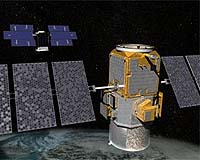
Greenbelt MD (SPX) Oct 26, 2005 Two NASA satellites, planned for launch no earlier than Oct. 26, will give us a unique view of Earth's atmosphere. CloudSat and Cloud-Aerosol Lidar and Infrared Pathfinder Satellite Observations (CALIPSO) are undergoing final preparations for launch from Vandenberg Air Force Base, Calif. CloudSat and CALIPSO will provide a new, 3-D perspective on Earth's clouds and airborne particles called aerosols. The satellites will answer questions about how clouds and aerosols form, evolve and affect water supply, climate, weather and air quality. CloudSat and CALIPSO employ revolutionary tools that will probe Earth's atmosphere. Each spacecraft carries an "active" instrument that transmits pulses of energy and measures the portion of the pulses scattered back to the instrument. CloudSat's cloud-profiling radar is more than 1,000 times more sensitive than typical weather radar. It can detect clouds and distinguish between cloud particles and precipitation. "The new information from CloudSat will answer basic questions about how rain and snow are produced by clouds, how rain and snow are distributed worldwide and how clouds affect the Earth's climate," said Dr. Graeme Stephens, CloudSat principal investigator at Colorado State University, Fort Collins, Colo. CALIPSO's polarization lidar instrument can detect aerosol particles and can distinguish between aerosol and cloud particles. "With the high resolution observation that CALIPSO will provide, we will get a better understanding of aerosol transport and how our climate system works," said Dr. David Winker, CALIPSO principal investigator at NASA's Langley Research Center, Hampton, Va. The satellites will be launched into a 438-mile circular, sun-synchronous polar orbit, where they will fly in formation just 15 seconds apart as members of NASA's "A-Train" constellation with three other Earth Observing System satellites. The A-Train includes NASA's Aqua and Aura satellites and France's PARASOL satellite. The usefulness of data from CloudSat, CALIPSO and the other A-Train satellites will be much greater when combined. The combined set of measurements will provide new insight into the global distribution and evolution of clouds that will lead to improvements in weather forecasting and climate prediction. CloudSat is managed by NASA's Jet Propulsion Laboratory. The radar instrument was developed at JPL, with hardware contributions from the Canadian Space Agency. Colorado State University provides scientific leadership and science data processing and distribution. Other contributions include resources from the U.S. Air Force and the U.S. Department of Energy. Ball Aerospace and Technologies Corp. designed and built the spacecraft. A host of U.S. and international universities and research centers provides support to the science team. Some of these activities are contributed as partnerships with the project. CALIPSO was developed through collaboration between NASA and the French Space Agency, Centre National d'Etudes Spatiales (CNES). NASA's Langley Research Center leads the CALIPSO mission and provides science team leadership, systems engineering, payload mission operations, and validation, processing and archiving of data. Langley also developed the lidar instrument in collaboration with the Ball Aerospace and Technologies Corp., which developed the onboard visible camera. NASA's Goddard Space Flight Center, Greenbelt, Md., provides project management, system engineering support and overall program management. CNES provides a PROTEUS spacecraft developed by Alcatel, the imaging infrared radiometer, payloadto- spacecraft integration and spacecraft mission operations. The Institut Pierre Simon Laplace in Paris provides the imaging infrared radiometer science oversight, data validation and archival. Hampton University provides scientific contributions and manages the outreach program. Community Email This Article Comment On This Article Related Links CloudSat at NASA CALIPSO at NASA SpaceDaily Search SpaceDaily Subscribe To SpaceDaily Express Earth Observation News - Suppiliers, Technology and Application
 New Legislation Initiated To Support Commercial Remote Sensing Industry
 New York NY (SPX) Jan 11, 2006
The importance of remotely sensed data and technologies to support natural disasters has prompted attention and action in Washington. New initiatives and legislation authorizing appropriations to the remote sensing industry will be discussed at Strategic Research Institute's U.S. Commercial Remote Sensing Industry conference, scheduled for February 9-10, 2006 in Washington D.C. |
|
|

| The content herein, unless otherwise known to be public domain, are Copyright 1995-2006 - SpaceDaily.AFP and UPI Wire Stories are copyright Agence France-Presse and United Press International. ESA PortalReports are copyright European Space Agency. All NASA sourced material is public domain. Additionalcopyrights may apply in whole or part to other bona fide parties. Advertising does not imply endorsement,agreement or approval of any opinions, statements or information provided by SpaceDaily on any Web page published or hosted by SpaceDaily. Privacy Statement |