|
 |
 |
 |
 |
 |
 |
 |
 |

 |
NASA Satellites Unearth Antarctic Plumbing System Clues to Leaks
Greenbelt MD (SPX) Feb 16, 2007 Imagine peering down from aboard an airplane flying at 35,000 feet and spotting changes in the thickness of a paper back book on a picnic blanket in New York City's Central Park. If you believe this impossible, NASA satellites are doing the equivalent of just that. From nearly 400 miles above the Earth, satellites have detected subtle rises and falls in the surface of fast-moving ice streams on the Antarctic ice sheet, a capability that also offers scientists an extraordinary view of interconnected waterways deep below that surface. "NASA's satellite instruments are so sensitive we're able to measure from space changes in the ice sheet's surface elevation of a mere three feet," said Robert Bindschadler, chief scientist of the Laboratory for Hydrospheric and Biospheric Sciences at NASA's Goddard Space Flight Center, Greenbelt, Md., and co-author of a related study published in the Feb. 16 issue of Science. With the aid of the satellites, Bindschadler and a team of scientists led by research geophysicist Helen Fricker of the Scripps Institution of Oceanography, La Jolla, Calif., revealed a new three-dimensional look at an extensive network of waterways beneath an active ice stream that acts like a natural "plumbing system", and clues to how "leaks" in the system impact the world's largest ice sheet and sea level. They also documented for the first time changes in the height of the ice sheet's surface as proof the lakes and channels nearly half a mile of solid ice below filled and emptied. "This exciting discovery of large lakes exchanging water under the ice sheet's surface has radically altered our view of what's happening at the base of the ice sheet and how ice moves in that environment," said Bindschadler. Fricker, Bindschadler and others spotted intriguing discharges of water from the lakes into the ocean. Their research has also delivered new insights into how much water "leaks" from these waterways, how frequently and how many connect to the ocean. Because Antarctica holds about 90 percent of the world's ice, and 70 percent of the world's reservoir of fresh water, "leaks" in this system influence sea level and ice melt worldwide. The research team combined images from an instrument aboard NASA's Terra and Aqua satellites and data from NASA's Ice Cloud and Land Elevation Satellite (ICESat) to unveil a first-ever view of changes in the elevation of the icy surface above a subglacial lake the size of Lake Ontario that took place over a three-year period. Those changes suggest the lake drained and that its water relocated elsewhere. To the naked eye, the surface of the ice sheet is very cold and stable, but the base of any of its ice streams is warm, enabling water, melted from the basal ice to flow, filling the system's "pipes" and lubricating flow of the overlying ice. These waterways act as a vehicle for water to move and change its influence on the ice movement, a factor that determines ice sheet growth or decay. "There's an urgency to learning more about ice sheets when you note that sea level rises and falls in direct response to changes in that ice," said Fricker. "With this in mind, NASA's ICESat, Terra, Aqua and other satellites are providing a vital public service." "An Active Subglacial Water System in West Antarctica Mapped From Space," by Helen Amanda Fricker at Scripps Institution of Oceanography in La Jolla, CA and University of California, San Diego in La Jolla, CA; Ted Scambos at University of Colorado in Boulder, CO; Robert Bindschadler at NASA Goddard Space Flight Center in Greenbelt, MD; Laurie Padman at Earth and Space Research in Corvallis, OR. This research was supported by NASA. Community Email This Article Comment On This Article Related Links Cryosphere at Goddard ICESat mission American Association for the Advancement of Science Beyond the Ice Age Learn about Climate Science at TerraDaily.com Beyond the Ice Age
 Study Finds Subglacial Water in West Antarctica Considerably More Active Than Previously Observed
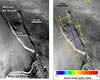 San Diego CA (SPX) Feb 16, 2007
The recent discovery of a subglacial water system beneath the West Antarctic ice sheet (WAIS) is causing scientists to rethink the mechanisms that control the flow of ice streams into the Ross Ice Shelf and ultimately into the Southern Ocean, according to a report in the February 15, 2007, issue of Science magazine online. |
|
|

| The content herein, unless otherwise known to be public domain, are Copyright 1995-2006 - SpaceDaily.AFP and UPI Wire Stories are copyright Agence France-Presse and United Press International. ESA PortalReports are copyright European Space Agency. All NASA sourced material is public domain. Additionalcopyrights may apply in whole or part to other bona fide parties. Advertising does not imply endorsement,agreement or approval of any opinions, statements or information provided by SpaceDaily on any Web page published or hosted by SpaceDaily. Privacy Statement |