|
 |
 |
 |
 |
 |
 |
 |
 |

 |
NASA Satellite Identifies The World's Most Intense Thunderstorms
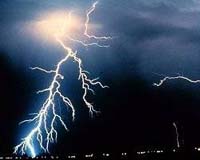
Greenbelt MD (SPX) Oct 27, 2006 A summer thunderstorm often provides much-needed rainfall and heat wave relief, but others bring large hail, destructive winds, and tornadoes. Now with the help of NASA satellite data, scientists are gaining insight into the distribution of such storms around much of the world. By using data from the NASA Tropical Rainfall Measuring Mission (TRMM) satellite, a study published in the August 2006 issue of the Bulletin of the American Meteorological Society identified the regions on Earth that experience the most intense thunderstorms. The strongest storms were found to occur east of the Andes Mountains in Argentina, where warm, humid air often collides with cooler, drier air, similar to storms that form east of the Rockies in the United States. Surprisingly, some semi-arid regions have powerful storms, including the southern fringes of the Sahara, northern Australia, and parts of the Indian subcontinent. In contrast, rainy areas such as western Amazonia, Southeast Asia, and Indonesia experience frequent storms, but relatively few are severe. Northern Pakistan, Bangladesh, and parts of Central Africa also experience intense thunderstorms. "TRMM has given us the ability to extend local knowledge about storms to a near-global reach," said lead author Edward Zipser, University of Utah, Salt Lake City, Utah. "In addition to containing the only precipitation radar in space, TRMM's other instruments provide a powerful overlap of data that is extremely useful for studying storms." The researchers examined global thunderstorm data supplied by TRMM from 1998-2004. To determine an individual storm's intensity, they specifically examined the height of radar echoes, radiation temperature, and lightning flash rate, each measured by separate TRMM instruments. The study also confirmed previous findings. For example, the locations of the heaviest rainfall on Earth - usually in tropical oceans and along certain mountain slopes - rarely coincide with the regions of most intense storms. They also found that the strongest storms tend to occur over land, rather than over the oceans. "Prior to TRMM, we could only study individual storms that were captured by a ground-based radar or lightning network," said co-author Daniel Cecil, University of Alabama-Huntsville, Huntsville, Ala. "Those instruments are not available in many places and trying to find an interesting storm that was simultaneously observed by a satellite required remarkable luck; but TRMM has been supplying a variety of measurements from individual storms around the world for nearly nine years now." While each TRMM instrument measures different aspects of a storm, the researchers found that the data from each usually matched quite well, agreeing on the location and distribution of the strongest storms. "The results from this study help to quantify the differences in the type and intensity of thunderstorms that occur in different climate regimes around the world," said Cecil. "The effects on the atmosphere of an intense, monstrous thunderstorm over Argentina or Oklahoma contrasts greatly with the effects from a more ordinary storm over the Amazon basin." In the future, and as the dataset from TRMM continues to increase, these observations will be used to test whether computer models used for climate prediction and weather forecasting are accurately capturing the details of thunderstorms. If not, scientists will have the details necessary to build better, more realistic models that will aid meteorologists in providing more accurate forecasts. The Tropical Rainfall Measuring Mission (TRMM) is a joint mission between NASA and the Japan Aerospace Exploration Agency (JAXA) designed to monitor and study tropical rainfall. Community Email This Article Comment On This Article Related Links TRMM Satellite NASA Lightning and Electricity Research at the Global Hydrology and Climate Center Goddard Space Flight Center A world of storm and tempest Bringing Order To A World Of Disasters When the Earth Quakes A world of storm and tempest
 NASA Looks At Sea Level Rise, Hurricane Risks To New York City
 New York NY (SPX) Oct 26, 2006
New York City has been an area of concern during hurricane season for many years because of the large population and logistics. More than 8 million people live in the city, and it has hundreds of miles of coastline that are vulnerable to hurricane threats. Using computer climate models, scientists at NASA have looked at rising sea levels and hurricane storm surge and will report on them at a science meeting this week. |
|
|

| The content herein, unless otherwise known to be public domain, are Copyright 1995-2006 - SpaceDaily.AFP and UPI Wire Stories are copyright Agence France-Presse and United Press International. ESA PortalReports are copyright European Space Agency. All NASA sourced material is public domain. Additionalcopyrights may apply in whole or part to other bona fide parties. Advertising does not imply endorsement,agreement or approval of any opinions, statements or information provided by SpaceDaily on any Web page published or hosted by SpaceDaily. Privacy Statement |