|
 |
 |
 |
 |
 |
 |
 |
 |

 |
NASA Rover Nears Martian Bowl Goal
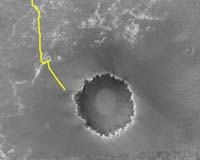
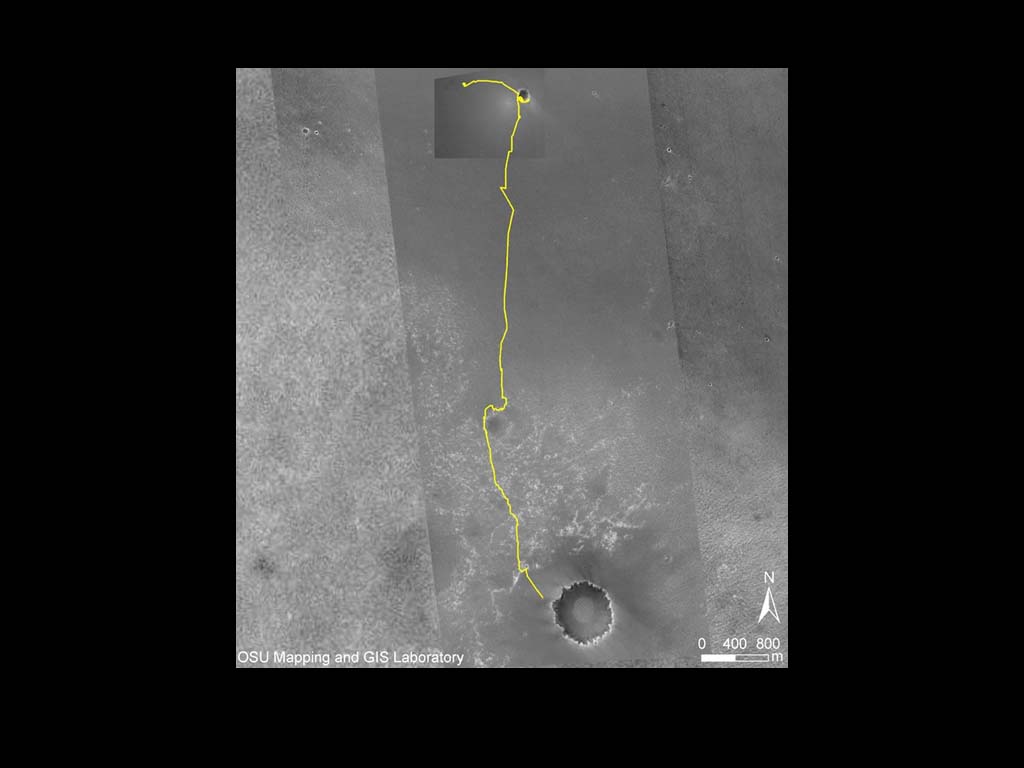
Pasadena CA (JPL) Sep 07, 2006 NASA's Mars rover Opportunity is closing in on what may be the grandest overlook and richest science trove of its long mission. During the next two weeks, the robotic geologist is likely to reach the rim of a hole in the Martian surface wider and deeper than any it has visited. The crater, known as "Victoria," is approximately 750 meters (half a mile) wide and 70 meters (230 feet) deep. Images from NASA's Mars Global Surveyor orbiter show the crater walls expose a stack of rock layers approximately 30 to 40 meters (100 to 130 feet) thick. Opportunity will send back its initial view into the crater as soon as it gets to the rim. Scientists and engineers will use Opportunity's observations from points around the rim to plot the best route for entering the crater. "Victoria has been our destination for more than half the mission," said Ray Arvidson of Washington University, St. Louis. Arvidson is deputy principal investigator for Opportunity and its twin rover, Spirit. "Examination of the rocks exposed in the walls of the crater will greatly increase our understanding of past conditions on Mars and the role of water. In particular, we are very interested in whether the rocks continue to show evidence for having been formed in shallow lakes." The NASA rovers have been exploring landscapes on opposite sides of Mars since January 2003. Their prime missions lasted three months. Both rovers are still investigating Mars' rocks, soils and atmosphere after more than 30 months. Opportunity works in a region where rock layers hundreds of meters or yards in thickness cover older, heavily cratered terrain. "We have a fully functional vehicle with all the instruments working. We're ready to hit Victoria with everything we've got," said Byron Jones, a rover mission manager at NASA's Jet Propulsion Laboratory, Pasadena, Calif. Though it's still winter in Mars' southern hemisphere, days have begun getting longer again, and Opportunity's power supply from its solar panels is increasing daily. During its first two months on Mars, Opportunity examined a 30-centimeter (one-foot) stack of rock layers at its landing site inside "Eagle Crater" and found geological evidence that water had flowed across the surface long ago. The rover spent the next nine months driving to and exploring a larger crater, "Endurance." There it examined a stack of exposed layers 7 meters (23 feet) thick. Over the drive from Endurance to Victoria, the rocks tell a history of shallow lakes, drier periods of shifting dunes and groundwater levels that rose and fell. Minerals indicate the ancient water was very acidic. The much thicker stack of revealed rock layers at Victoria beckons. Arvidson said, "We want to examine the thick section of rocks exposed on the walls in Victoria crater to understand whether the environment that produced these materials was similar to the environment recorded in the rocks that we have seen so far. Is there a record of a different type of deposition? Was there a wet environment that was less acidic, perhaps even more habitable? Where do the layers from Endurance fit in this thicker sequence?" NASA's Mars Reconnaissance Orbiter reached Mars in March 2006. It will begin its primary science phase in November, offering higher resolution images and mineral mapping than have been possible with previous orbiters. Victoria will be one target for the orbiter. "By combining the data from Opportunity and Mars Reconnaissance Orbiter, we'll be able to do some fantastic coordinated analysis," Arvidson said. Such analysis will enhance the science return of both missions and aid in interpreting orbiter data taken of potential landing sites for future missions elsewhere on Mars. "It's an amazing accomplishment that Spirit and Opportunity have completed the equivalent of 10 prime missions," said John Callas, rover project manager at JPL. "Each of them shows some signs of aging, though. We can't say how long the rovers will last, but we will push to get the best possible science out of these national treasures as long as they keep operating. Victoria could very well be the most productive and exciting science of the entire mission." Community Email This Article Comment On This Article Related Links Mars Rovers at JPL Mars Rovers at Cornell Mars News and Information at MarsDaily.com Lunar Dreams and more
 Spirit Recovers From Reset And Makes Finishing Touches To Winter Panorama
 Pasadena CA (SPX) Sep 06, 2006
Spirit experienced a software reset during the evening overpass of the Odyssey orbiter on sol 944 (Aug. 29, 2006). The rover was in the process of receiving command sequences for the following two Martian days, sols 945 and 946 (Aug. 30-31, 2006). |
|
|

| The content herein, unless otherwise known to be public domain, are Copyright 1995-2006 - SpaceDaily.AFP and UPI Wire Stories are copyright Agence France-Presse and United Press International. ESA PortalReports are copyright European Space Agency. All NASA sourced material is public domain. Additionalcopyrights may apply in whole or part to other bona fide parties. Advertising does not imply endorsement,agreement or approval of any opinions, statements or information provided by SpaceDaily on any Web page published or hosted by SpaceDaily. Privacy Statement |