|
 |
 |
 |
 |
 |
 |
 |
 |

 |
NASA Robots Come Down To Sea
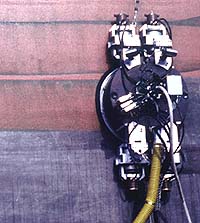
Pasadena - April 17, 2000 - A new robotic device that safely strips paint from the hulls of ships without polluting the environment is based on NASA robotics technology. The system, which has received kudos from environmentalist and undersea explorer Jean-Michel Cousteau, could revolutionize paint removal in the shipping industry. Current sandblasting methods potentially can contaminate waters surrounding harbors. Developed by NASA's Jet Propulsion Laboratory, Pasadena, CA; the Robotics Engineering Consortium at Carnegie Mellon University, Pittsburgh, PA; and UltraStrip Systems, Inc., Stuart, FL, the new system consists of an automated robotic device that is magnetized to the ship, a set of high-pressure jet streams, and a controller that helps the robot navigate along the surface of the ship. The water is filtered and then reused, while the paint residue is collected in a container and can then be disposed of safely. Using this method, no toxic dust or paint flakes are generated to pollute nearby areas or to be inhaled by system operators. "Having now personally seen demonstrations of the M2000, I know the system works," said Cousteau, president of Ocean Futures, Santa Barbara, CA. "It is inspiring to see a technology that can have such a positive environmental impact while at the same time providing a benefit to the profitability of the shipyard industry." "Robotics technology developed at the various NASA centers has resulted in new products ranging from automated harvesting, coal mining, earth moving, and material transport to robotic inspection and repair for gas pipelines, and agricultural spraying, to name a few," said Dr. Neville Marzwell, who heads Advanced Concepts and Technology Innovations at JPL. Previous stripping methods sandblasted paint from a Ship's hull, producing large amounts of toxic airborne dust and exposing workers, nearby communities and the environment to significant risks. The new method, which uses UltraStrip's patented Robotic M2000 hydroblasting technology, uses only water in the paint-removal process and produces dried paint chips and clean water. Since a powerful vacuum collects all water and paint, nothing can escape to pollute the environment. "We feel that the UltraStrip application is an excellent match with our commercialization goals. This system gives us a great opportunity to showcase robotics technology in a significant commercial application which will benefit the environment at the same time," said Bill Ross, consortium project manager. Still in development are computer-vision-based cruise control; sensors to detect surface quality, paint thickness, and any paint left on the hull; and diagnostic and analytic tools to optimize the speed of the robot for efficient and effective operations. The technology was created under the National Robotics Engineering Consortium -- a NASA, industry, and university partnership to develop new industrial products and services from technologies that help solve key problems and reinvigorate the U.S. robotics industry. Consortium activities provide a process to move rapidly developing robotics technology into industrial applications, and, in turn, to provide next-generation technology products for the Agency's science missions. The consortium also provides hands-on experience to students who will be the next generation of robotics scientists, technologists, and engineers. The consortium is managed by Marzwell at JPL, and Rick Kadunc from the Office of Space Science at NASA Headquarters, Washington, DC. UltraStrip's president is Dennis McGuire. Cousteau is also on the board of UltraStrip.
Email This Article Comment On This Article Related Links Space
 Satellite Launch To Boost DTH In India
 Calcutta, India (SPX) Dec 28, 2005
The successful launch Thursday of India's heaviest satellite from spaceport of Kourou in French Guyana may have boosted the country's space research efforts to yet another level, but it has also lifted the spirits of at least three Direct-To-Home televisions broadcasters, one of which has been waiting for years to launch its services in India. |
|
|

|
|
|
|
|
|
|
|
|
|
|
|
| The content herein, unless otherwise known to be public domain, are Copyright 1995-2006 - SpaceDaily.AFP and UPI Wire Stories are copyright Agence France-Presse and United Press International. ESA PortalReports are copyright European Space Agency. All NASA sourced material is public domain. Additionalcopyrights may apply in whole or part to other bona fide parties. Advertising does not imply endorsement,agreement or approval of any opinions, statements or information provided by SpaceDaily on any Web page published or hosted by SpaceDaily. Privacy Statement |