|
 |
 |
 |
 |
 |
 |
 |
 |

 |
NASA Restructures Aeronautics Research
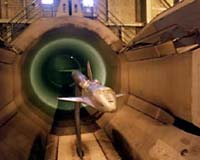
Washington DC (SPX) Jan 16, 2006 In a move designed to better align the agency's aeronautics research, Lisa Porter, NASA's associate administrator of the Aeronautics Research Mission Directorate, announced a comprehensive restructuring of research programs. "NASA is returning to long-term investment in cutting-edge fundamental research in traditional aeronautics disciplines," Porter said. "We are investing in research for the long-term in areas that are appropriate to NASA's unique capabilities and meeting our charter of addressing national needs and benefiting the public good." Porter stated four key objectives guide this new focus: Re-establish our commitment to mastering the science of subsonic (rotary and fixed wing), supersonic, and hypersonic flight. Protect and maintain NASA's key aeronautics research & test facilities as national assets. Focus research in areas that are appropriate to NASA's unique capabilities. Directly address the needs of the next generation air transportation system in partnership with the Joint Planning and Development Office. The new programs include fundamental aeronautics, airspace systems, aviation safety, and the aeronautics test program. The goal of the fundamental aeronautics program is the development of system-level, multi-disciplinary capabilities for both civilian and military applications. This program provides long-term investment in research to support and sustain expert competency in critical core areas of aeronautics technology. The work in fundamental aeronautics will produce knowledge, data, capabilities, and design tools to benefit a variety of air vehicles. Fundamental aeronautics concentrates research in four areas: subsonic fixed wing, subsonic rotary wing, supersonics, and hypersonics. The airspace systems program is responding to our nation's urgent need to transform its air transportation system. The transformation includes both the operational management of our national airspace system, as well as the types of aircraft that fly within it. The primary research role for the program is the operational aspects of the airspace system. The program will be responsible for developing concepts, capabilities, and technologies for high-capacity, efficient, and safe airspace and airport systems. The research focus of the aviation safety program is on the way vehicles are designed, built, operated, and maintained. Scientists and engineers in this program will develop principles, guidelines, concepts, tools, methods, and technologies to address four areas: aircraft aging and durability, integrated intelligent flight deck technologies, integrated vehicle health management, and integrated resilient aircraft control. The aeronautics test program will ensure NASA wind tunnels and air-breathing propulsion test facilities are available to meet research requirements and those of other national partners. The program will make decisions regarding the strategic use, operations, maintenance, and investment for facilities at NASA's Ames Research Center, Moffett Field, Calif.; Glenn Research Center, Cleveland; and Langley Research Center, Hampton, Va. Community Email This Article Comment On This Article Related Links Aeronautics Research Mission Directorate SpaceDaily Search SpaceDaily Subscribe To SpaceDaily Express Space Tourism, Space Transport and Space Exploration News
 NASA Refines Design For Crew Exploration Vehicle
 Washington DC (SPX) Jan 12, 2006
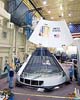
NASA's Constellation Program is making progress toward selecting a prime contractor to design, develop and build the Crew Exploration Vehicle (CEV), America's first new human spacecraft in 30 years. |
|
|

| The content herein, unless otherwise known to be public domain, are Copyright 1995-2006 - SpaceDaily.AFP and UPI Wire Stories are copyright Agence France-Presse and United Press International. ESA PortalReports are copyright European Space Agency. All NASA sourced material is public domain. Additionalcopyrights may apply in whole or part to other bona fide parties. Advertising does not imply endorsement,agreement or approval of any opinions, statements or information provided by SpaceDaily on any Web page published or hosted by SpaceDaily. Privacy Statement |