|
 |
 |
 |
 |
 |
 |
 |
 |

 |
NASA Research Finds Green Sand Crystals Are In Comet Tempel 1
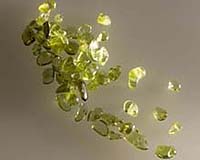
Ames CA (SPX) Sep 16, 2005 Green sand found on the big island of Hawaii resembles olivine crystals in the icy interior of comet Tempel 1, according to a NASA astrophysicist. Gemini mid-infrared, false color images of comet Tempel 1 minutes before impact (left), 3 hours after (center) and 24 hours after impact (right.) This image can be used for personal, educational, non-profit use and news media stories, according to Gemini. Scientists revealed that they detected green silicate crystals (olivine) in Tempel 1 similar to, but smaller than, Hawaiian green sand particles, according to articles by the researchers in the September 15, 2005 issue of the journal Science Express. They made their observations before, during and after the NASA Deep Impact spacecraft's 820-pound 'impactor' collided with the comet in early July 2005, as planned, so astronomers could determine what is in comets. The papers outline findings scientists made using infrared detectors on the Gemini and Subaru telescopes in Hawaii. "The silicate crystals are talcum powder-size, but they are made of the same materials as the green sand beaches in Hawaii," said Diane Wooden, a co-author of both papers. She is an astrophysicist at NASA Ames Research Center, located in California's Silicon Valley. The principal author of the Gemini Telescope paper is David Harker, University of California, San Diego. Seiji Sugita of the University of Tokyo is the principal author of the second Subaru Telescope paper. "Following the collision of the comet with the 'impactor,' there was a short-lived gas geyser associated with the impact site that carried the crystals from Tempel 1 into space," Wooden said. "The Gemini and the Subaru telescopes are two of the biggest in the world, and we were able to focus in on the green dust particles in the jet and ejecta � something that most space-borne telescopes could not see in infrared light," she noted. "The insides of comet Tempel 1 look very much like the outsides of comets that have not been 'cooked' by passages close to the sun," Wooden said. She explained that there might be green silicates on the surfaces of comets that swarm in the outer reaches of the solar system and are not exposed to intense sunshine. Another comet, Hale-Bopp, was so active that it released green silicate crystals as it passed close to the sun in 1997, according to Wooden. "However, the Deep Impact spacecraft's 'impactor' had to blast the green silicate crystals from the interior of the comet Tempel 1 for us to see them with our ground-based instruments," she noted. Olivine particles are from the Green Sand Beach in Hawaii. Photo Credit: NASA Ames Research Center, Tom Trower. Tempel 1 travels close to the sun during part of the comet's orbit, and strong sunlight hits the comet, causing its surface gases and other particles to fly off into space. These particles are what make up a comet's tail, which forms nearer the sun. "In Tempel 1's case, it has passed near the sun so many times that it has lost much of its surface gases and particles," said Wooden. "What's incredible to me is that the surface � or maybe the fluffiness of the body of Tempel 1 - is protecting the primitive particles and gases just below the surface from being out-gassed," ventured Wooden. "We discovered crystalline silicates in the dust that flew from the comet after its collision with the Deep Impact 'impactor.' We don't usually see these silicates in comets that have been 'cooked' by the sun," Wooden explained. Community Email This Article Comment On This Article Related Links SpaceDaily Search SpaceDaily Subscribe To SpaceDaily Express Asteroid and Comet Mission News, Science and Technology
 NASA'S Spitzer Finds Possible Comet Dust Around Dead Star
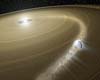 Pasadena CA (SPX) Jan 12, 2006
NASA's Spitzer Space Telescope has spotted what may be comet dust sprinkled around the white dwarf star G29-38, which died approximately 500 million years ago. |
|
|

| The content herein, unless otherwise known to be public domain, are Copyright 1995-2006 - SpaceDaily.AFP and UPI Wire Stories are copyright Agence France-Presse and United Press International. ESA PortalReports are copyright European Space Agency. All NASA sourced material is public domain. Additionalcopyrights may apply in whole or part to other bona fide parties. Advertising does not imply endorsement,agreement or approval of any opinions, statements or information provided by SpaceDaily on any Web page published or hosted by SpaceDaily. Privacy Statement |