|
 |
 |
 |
 |
 |
 |
 |
 |

 |
NASA Releases Plans For Next Generation Spacecraft
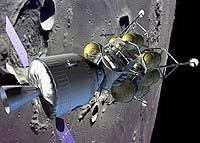
Washington DC (SPX) Sep 20, 2005 NASA Administrator Michael Griffin today released the results of the agency's exploration architecture study - a blueprint for the next generation of spacecraft to take humans back to the moon and on to Mars and other destinations. The study makes specific design recommendations for a vehicle to carry crews into space, a family of launch vehicles to take crews to the moon and beyond, and a "lunar mission architecture" for landing on the moon. It also recommends the technologies NASA should pursue in the near term. The study will assist NASA in achieving President Bush's Vision for Space Exploration, which calls for the agency to safely return the space shuttle to flight, complete the International Space Station, return to the moon, and continue exploration of Mars and beyond. America's next generation spacecraft will use an improved, blunt-body crew capsule, and will accommodate up to six people. "This spacecraft and its systems will build upon the foundation of the proven designs and technologies used in the Apollo and space shuttle programs, while having far greater capability," Griffin said. "It will be able to carry larger and heavier cargos into space and allow more people to stay on the moon for longer periods of time." The new spacecraft can be configured either to support human explorers or fly unpiloted to carry cargo. Its design allows the flexibility to ferry crews of three astronauts, plus additional supplies, to and from the International Space Station, take four crew members to lunar orbit, and eventually maintain up to six astronauts on a mission to Mars. Crews and cargo will be carried into orbit by a space shuttle-derived launch system, consisting of a solid rocket booster and an upper stage powered by a shuttle main engine that can lift 25 metric tons. The spacecraft also will be 10 times safer than the space shuttle because of its in-line design and launch-abort system. NASA chose the shuttle-derived option for its launch system due to its superior safety, cost and its availability. Specifically, the space shuttle's main engines and solid rocket boosters are reliable and rated for human space flight. Much of the industrial base and hardware to support this option are already in place, which will significantly lower development costs. Future lunar exploration missions will be supported by a heavy cargo launch vehicle consisting of five space shuttle main engines, and two five-segment shuttle solid-propellant rocket boosters. This combination yields a lift capability of 106 metric tons to low Earth orbit, and 125 metric tons, if it incorporates an Earth-departure stage. Although primarily designed to carry cargo, this system can be human-rated to carry crew into orbit. The study lays out a deliberate, milestone-driven journey to the moon for NASA. Returning to the moon and sustaining a presence there will demonstrate humans can survive on another world, and will build confidence that astronauts can venture still farther into space and stay for longer periods. NASA's return to the moon will open opportunities for fundamental science in astrobiology, lunar geology, exobiology, astronomy and physics. The journey will start with robotic missions between 2008 and 2011 to study, map and learn about the lunar surface. These early missions will help determine lunar landing sites and whether resources, such as oxygen, hydrogen and metals, are available for use in NASA's long-term lunar exploration objectives. All NASA field centers will participate in the new exploration initiative. Community Email This Article Comment On This Article Related Links SpaceDaily Search SpaceDaily Subscribe To SpaceDaily Express Mars News and Information at MarsDaily.com Lunar Dreams and more
 SMART 1 Uses New Imaging Technique In Lunar Orbit
 Paris, France (ESA) Dec 28, 2005
ESA's SMART-1 spacecraft has been surveying the Moon's surface in visible and near-infrared light using a new technique, never before tried in lunar orbit. |
|
|

| The content herein, unless otherwise known to be public domain, are Copyright 1995-2006 - SpaceDaily.AFP and UPI Wire Stories are copyright Agence France-Presse and United Press International. ESA PortalReports are copyright European Space Agency. All NASA sourced material is public domain. Additionalcopyrights may apply in whole or part to other bona fide parties. Advertising does not imply endorsement,agreement or approval of any opinions, statements or information provided by SpaceDaily on any Web page published or hosted by SpaceDaily. Privacy Statement |