|
 |
 |
 |
 |
 |
 |
 |
 |

 |
NASA Prepares For Arrival Of Comet Samples To Houston
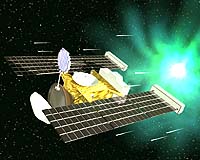
Houston (SPX) Oct 17, 2005 Particles gathered near a comet in deep space that are due to arrive at NASA's Johnson Space Center (JSC), Houston, in January may help scientists better understand comets and their role in the early solar system. NASA's Stardust spacecraft, which collected particles from comet Wild 2 in January 2004, will complete its two-year, 708-million-mile trek back to Earth in January 2006. The capsule will be transported to JSC and stored in the Stardust Laboratory where scientists will make the first analyses of freshly collected cometary and interstellar particles. Stardust recovery and science team members met at JSC the week of Oct. 3-7 to rehearse the steps that will be involved in recovering the samples from the Stardust capsule. A canister was transported to JSC and placed in the Stardust clean room. There, scientists removed the Stardust sample trays and rehearsed techniques they will use to document, process and analyze the cometary and interstellar particles. "The spacecraft recovery team and the mission science team were at JSC all week to shake down procedures for opening the sample canister and harvesting and analyzing the captured samples," said Mike Zolensky, Stardust co- investigator and NASA space scientist in JSC's Astromaterials Research and Exploration Science Directorate. The Stardust spacecraft was launched in February 1999. It encountered its target, comet Wild 2, on Jan. 2, 2004. In addition to capturing samples of cometary material for return to Earth, Stardust collected grains from a stream of particles from interstellar space. The spacecraft will release a capsule containing the sample particles for landing at the Air Force's Utah Test and Training Range early Jan. 15, 2006. Community Email This Article Comment On This Article Related Links NASA's Stardust mission JSC Stardust Curation Team SpaceDaily Search SpaceDaily Subscribe To SpaceDaily Express Asteroid and Comet Mission News, Science and Technology
 NASA'S Spitzer Finds Possible Comet Dust Around Dead Star
 Pasadena CA (SPX) Jan 12, 2006
NASA's Spitzer Space Telescope has spotted what may be comet dust sprinkled around the white dwarf star G29-38, which died approximately 500 million years ago. |
|
|

| The content herein, unless otherwise known to be public domain, are Copyright 1995-2006 - SpaceDaily.AFP and UPI Wire Stories are copyright Agence France-Presse and United Press International. ESA PortalReports are copyright European Space Agency. All NASA sourced material is public domain. Additionalcopyrights may apply in whole or part to other bona fide parties. Advertising does not imply endorsement,agreement or approval of any opinions, statements or information provided by SpaceDaily on any Web page published or hosted by SpaceDaily. Privacy Statement |