
 |
 |
 |
 |
 |
 |
 |
 |
 |

 |
NASA's Phoenix Mars Lander Works Through the Night
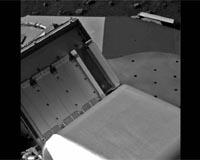
Tucson AZ (SPX) Jul 22, 2008 To coordinate with observations made by an orbiter flying repeatedly overhead, NASA's Phoenix Mars Lander is working a schedule Monday that includes staying awake all night for the first time. Phoenix is using its weather station, stereo camera and conductivity probe to monitor changes in the lower atmosphere and ground surface at the same time NASA's Mars Reconnaissance Orbiter studies the atmosphere and ground from above. The lander's fork-like thermal and conductivity probe was inserted into the soil Sunday for more than 24 hours of measurements coordinated with the atmosphere observations. One goal is to watch for time-of-day changes such as whether some water alters from ice phase to vapor phase and enters the atmosphere from the soil. "We are looking for patterns of movement and phase change," said Michael Hecht, lead scientist for Phoenix's Microscopy, Electrochemistry and Conductivity Analyzer, which includes the conductivity probe. "The probe is working great. We see some changes in soil electrical properties, which may be related to water, but we're still chewing on the data." The extended work shift for the lander began Sunday afternoon Pacific Time. In Mars time at the landing site, it lasts from the morning of Phoenix's 55th Martian day, or sol, to the afternoon of its 56th sol. The Phoenix team's plans for Sol 56 also include commanding the lander to conduct additional testing of the techniques for collecting a sample of icy soil. When the team is confident about the collecting method, it plans to use Phoenix's robotic arm to deliver an icy sample to an oven of the Thermal and Evolved-Gas Analyzer (TEGA). The TEGA instrument successfully opened both doors Saturday for the oven chosen to get the first icy sample. Images from the Surface Stereo Camera confirmed that the doors are wide open. Community Email This Article Comment On This Article Share This Article With Planet Earth
Related Links Mars News and Information at MarsDaily.com Lunar Dreams and more
 A Workday On Mars Is More Than 9-to-5:40
 Dallas TX (SPX) Jul 21, 2008
The average day, or "sol," on Mars is 40 minutes longer than our 24-hour day on Earth. UT Dallas Physics Professor John Hoffman has spent more than 50 days on Martian time analyzing soil from the surface of the Red Planet. |
|
|

| The content herein, unless otherwise known to be public domain, are Copyright 1995-2007 - SpaceDaily.AFP and UPI Wire Stories are copyright Agence France-Presse and United Press International. ESA Portal Reports are copyright European Space Agency. All NASA sourced material is public domain. Additional copyrights may apply in whole or part to other bona fide parties. Advertising does not imply endorsement,agreement or approval of any opinions, statements or information provided by SpaceDaily on any Web page published or hosted by SpaceDaily. Privacy Statement |
 del.icio.us
 Digg
Digg Reddit
 YahooMyWeb
 Google
 Facebook