
 |
 |
 |
 |
 |
 |
 |
 |
 |

 |
NASA's Phoenix Lander Might Peek Under A Rock
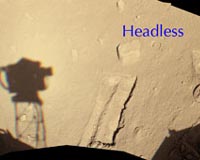
Tucson AZ (SPX) Sep 23, 2008 If the robotic arm on NASA's Phoenix Mars Lander can nudge a rock aside, scientists on the Phoenix team would like to see what's underneath. Engineers who develop commands for the robotic arm have prepared a plan to try displacing a rock on the north side of the lander. This rock, roughly the size and shape of a VHS videotape, is informally named "Headless." "We don't know whether we can do this until we try," said Ashitey Trebi Ollennu, a robotics engineer at NASA's Jet Propulsion Laboratory, Pasadena, Calif. "The idea is to move the rock with minimum disturbance to the surface beneath it. You have to get under it enough to lift it as you push it and it doesn't just slip off the scoop." The lander receives commands for the whole day in the morning, so there's no way to adjust in mid-move if the rock starts slipping. Phoenix took stereo-pair images of Headless to provide a detailed three-dimensional map of it for planning the arm's motions. On Saturday, Sept. 20, the arm enlarged a trench close to Headless. Commands sent to Phoenix Sunday evening, Sept. 21, included a sequence of arm motions for today, intended to slide the rock into the trench. Moving rocks is not among the many tasks Phoenix's robotic arm was designed to do. If the technique works, the move would expose enough area for digging into the soil that had been beneath Headless. "The appeal of studying what's underneath is so strong we have to give this a try," said Michael Mellon, a Phoenix science team member at the University of Colorado, Boulder. The scientific motive is related to a hard, icy layer found beneath the surface in trenches that the robotic arm has dug near the lander. Excavating down to that hard layer underneath a rock might provide clues about processes affecting the ice. "The rocks are darker than the material around them, and they hold heat," Mellon said. "In theory, the ice table should deflect downward under each rock. If we checked and saw this deflection, that would be evidence the ice is probably in equilibrium with the water vapor in the atmosphere." An alternative possibility, if the icy layer were found closer to the surface under a rock, could be the rock collecting moisture from the atmosphere, with the moisture becoming part of the icy layer. Community Email This Article Comment On This Article Share This Article With Planet Earth
Related Links Mars News and Information at MarsDaily.com Lunar Dreams and more
 Morning Frost In Trench Dug By Phoenix
 Pasadena CA (SPX) Sep 23, 2008
This image from the Surface Stereo Imager on NASA's Phoenix Mars Lander shows morning frost inside the "Snow White" trench dug by the lander, in addition to subsurface ice exposed by use of a rasp on the floor of the trench. |
|
|

| The content herein, unless otherwise known to be public domain, are Copyright 1995-2007 - SpaceDaily.AFP and UPI Wire Stories are copyright Agence France-Presse and United Press International. ESA Portal Reports are copyright European Space Agency. All NASA sourced material is public domain. Additional copyrights may apply in whole or part to other bona fide parties. Advertising does not imply endorsement,agreement or approval of any opinions, statements or information provided by SpaceDaily on any Web page published or hosted by SpaceDaily. Privacy Statement |
 del.icio.us
 Digg
Digg Reddit
 YahooMyWeb
 Google
 Facebook