
 |
 |
 |
 |
 |
 |
 |
 |
 |

 |
NASA Phoenix Lander Bakes Sample As Arm Digs Deeper
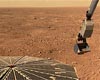
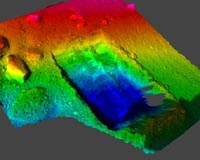
Tucson AZ (SPX) Jun 18, 2008 One of the ovens on NASA's Phoenix Mars Lander continued baking its first sample of Martian soil over the weekend, while the Robotic Arm dug deeper into the soil to learn more about white material first revealed on June 3. "The oven is working very well and living up to our expectations," said Phoenix co-investigator Bill Boynton of the University of Arizona, Tucson. Boynton leads the Thermal and Evolved-Gas Analyzer (TEGA), or oven instrument, for Phoenix. Phoenix has eight separate tiny ovens to bake and sniff the soil and look for volatile ingredients, such as water. This baking is performed at three different temperature ranges. On Sol 18 (June 12), the lander's Robotic Arm dug deeper into the two trenches, informally called "Dodo" and "Goldilocks," where white material was previously found. This created one large trench, now called "Dodo-Goldilocks." "We have continued to excavate in the Dodo-Goldilocks trench to expose more of the light-toned material, and we will monitor the site," said Robotic Arm lead scientist Ray Arvidson of the University of Washington, St. Louis. "If the material is ice, it should change with time. Frost may form on it, or it could slowly sublimate." Sublimation is the process where a solid changes directly into gas. The Dodo-Goldilocks trench is 22 centimeters wide (8.7 inches) and 35 centimeters long (13.8 inches). The trench is seven to eight centimeters (2.7 to 3 inches) deep at its deepest. The deepest portion is closest to the lander. The white material is located only at the shallowest part of the trench, farthest from the lander, indicating that it is not continuous throughout the excavated site. The trench might be exposing a ledge, or only a portion of a slab, of the white material, according to scientists. Community Email This Article Comment On This Article Share This Article With Planet Earth
Related Links Phoenix at LPL Phoenix at NASA Mars News and Information at MarsDaily.com Lunar Dreams and more
 NASA's Phoenix Mars Lander Inspects Delivered Soil Samples
 Tucson AZ (SPX) Jun 16, 2008
New observations from NASA's Phoenix Mars Lander provide the most magnified view ever seen of Martian soil, showing particles clumping together even at the smallest visible scale. |
|
|

| The content herein, unless otherwise known to be public domain, are Copyright 1995-2007 - SpaceDaily.AFP and UPI Wire Stories are copyright Agence France-Presse and United Press International. ESA Portal Reports are copyright European Space Agency. All NASA sourced material is public domain. Additional copyrights may apply in whole or part to other bona fide parties. Advertising does not imply endorsement,agreement or approval of any opinions, statements or information provided by SpaceDaily on any Web page published or hosted by SpaceDaily. Privacy Statement |
 del.icio.us
 Digg
Digg Reddit
 YahooMyWeb
 Google
 Facebook