|
 |
 |
 |
 |
 |
 |
 |
 |

 |
NASA Observations Improve Hurricane Forecasts
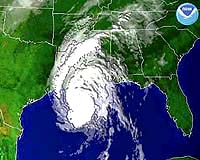
Hampton - May 28, 2003 With hurricane season approaching, scientists find that NASA observations can significantly improve predictions of both the direction and strength of hurricanes. Moisture measurements collected by a NASA Langley Research Center instrument could improve computer-predicted estimates of a hurricane's track by 100 kilometers (62 miles) and intensity by 20-25 percent for three-day forecasts. Scientists collected moisture measurements from the Lidar Atmospheric Sensing Experiment (LASE) on a NASA DC-8 as the aircraft flew over, through and around hurricanes during NASA's fourth Convection And Moisture Experiment (CAMEX) in 2001. A computer model, developed by the Florida State University (FSU) in Tallahassee, generated predictions based on operational satellite observations -- the same imagery we see in television weather forecasts -- both with and without CAMEX-4 LASE data. The scientists found the predictions that use LASE data provided more accurate forecasts for CAMEX-4 hurricanes Erin, Humberto and Gabrielle. In general LASE data improve the estimates of the hurricanes' tracks by 100 kilometers and intensities by 20-25 percent for three-day forecasts. "Improving our forecast capability would significantly benefit the financial security and public safety for the coastal regions of the U.S. and, ultimately, over other coastal regions of the world impacted by hurricanes and typhoons," said Edward Browell, the principal investigator for the experiment. Browell and Langley colleagues -- Syed Ismail and Rich Ferrar -- provided data on their study in a paper published recently in Geophysical Research Letters. Forecast models currently give a coastline region of about 700 kilometers (434 miles) indicating where a hurricane will first approach land and, subsequently, where warnings and evacuation orders will be given to residents. "A 100-kilometer improvement in our ability to predict where a hurricane will strike land will save an estimated 50 million dollars in preparation and evacuation costs and increase public confidence and response to hurricane forecasts," Ismail said. Although not tested in real time, scientists also believe that the FSU predictions using LASE data would have been more accurate than other forecasts for the same hurricanes. The difference is due in part to the FSU model including advanced capabilities for simulating processes related to moisture and the transfer of energy or heat in hurricanes. This study confirms the importance of detailed moisture profiles, like those provided by LASE, for hurricane forecasts. "LASE helps define the energy source for hurricanes by better understanding how much moisture is flowing into them," Browell said. When water vapor releases heat or energy as it changes phases, it channels energy into the atmosphere. If atmospheric conditions are right, water vapor becomes the main energy source for hurricane development. By better understanding the energy source of hurricanes, researchers can more accurately predict how hurricanes will develop and intensify and, perhaps most importantly, where they will approach land. NASA's Earth Science Enterprise, charged with fulfilling NASA's mission to understand and protect our home planet, supported the work of the LASE team in CAMEX-4. Community Email This Article Comment On This Article Related Links Lidar at NASA CAMEX at NASA SpaceDaily Search SpaceDaily Subscribe To SpaceDaily Express Dirt, rocks and all the stuff we stand on firmly
 Rescuers Seek Survivors As Phillipines Storm Leaves 300 Dead, 150 Missing
 Real, Philippines (AFP) Nov 30, 2004
Rescuers were desperately searching for survivors Tuesday after floods and landslides unleashed by a tropical storm in the Philippines killed more than 300 people and left at least 150 others missing, many buried alive under tonnes of debris. |
|
|

| The content herein, unless otherwise known to be public domain, are Copyright 1995-2006 - SpaceDaily.AFP and UPI Wire Stories are copyright Agence France-Presse and United Press International. ESA PortalReports are copyright European Space Agency. All NASA sourced material is public domain. Additionalcopyrights may apply in whole or part to other bona fide parties. Advertising does not imply endorsement,agreement or approval of any opinions, statements or information provided by SpaceDaily on any Web page published or hosted by SpaceDaily. Privacy Statement |