|
 |
 |
 |
 |
 |
 |
 |
 |

 |
NASA Names Shuttle Successor Rocket Ares
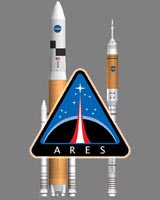
Cape Canaveral (AFP) Jun 30, 2006 NASA announced Friday that it has chosen Ares I and Ares V as the names for the rockets that will launch the aging space shuttle's successor to the Moon and Mars. The disclosure of the new generation launcher's name came in the final hours of the US space agency's countdown to Saturday's Discovery shuttle launch, a crucial mission four years before the shuttle's retirement. "It's appropriate that we named these vehicles Ares, which is a pseudonym for Mars," Scott Horowitz, associate administrator for NASA's Exploration Systems Mission Directorate, said in a statement. Ares I is the name for the future single five-segment solid rocket booster that will take the astronauts' Crew Exploration Vehicle (CEV) into space, while Ares V is the name of a larger launcher that will carry cargo. NASA has not chosen the name for the CEV, the capsule that the space agency hopes will return astronauts to the Moon by 2018 and eventually take them to Mars. The Roman numerals chosen for Ares pay homage to the Saturn I and Saturn V rockets of the Apollo program, officials said. "We honor the past with the number designations and salute the future with a name that resonates with NASA's exploration mission," Horowitz said. Two groups of companies are competing for the contract to build the CEV. The winner will be named in September, officials said. Officials previously said the contract would be awarded in August.
Source: Agence France-Presse Community Email This Article Comment On This Article Related Links Exploration at NASA Space Tourism, Space Transport and Space Exploration News
 NASA To Study Plants To Help Astronauts Grow Food In Space
 Moffett Field CA (SPX) Jul 13, 2006
Someday, astronauts may grow food efficiently in space and use plants to clean spaceship air, thanks to a two-year experiment scheduled aboard the International Space Station. |
|
|

| The content herein, unless otherwise known to be public domain, are Copyright 1995-2006 - SpaceDaily.AFP and UPI Wire Stories are copyright Agence France-Presse and United Press International. ESA PortalReports are copyright European Space Agency. All NASA sourced material is public domain. Additionalcopyrights may apply in whole or part to other bona fide parties. Advertising does not imply endorsement,agreement or approval of any opinions, statements or information provided by SpaceDaily on any Web page published or hosted by SpaceDaily. Privacy Statement |