
 |
 |
 |
 |
 |
 |
 |
 |
 |

 |
NASA Mission To Answer Lingering Questions From Deep Blue Sea
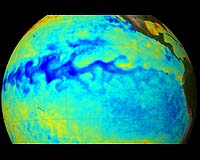
Washington DC (SPX) Jun 26, 2008 Ocean tides and currents across the globe still hold within their watery grasp the key to unanswered questions about our planet. Scientists hope the new follow-on mission to the Jason 1 and Topex/Poseidon satellite missions, equipped with the latest high-tech instruments, will bring them closer to answering broad fundamental questions: How does ocean circulation vary from season to season, from year to year and from decade to decade? How much can the ocean change from natural and human-induced causes? In what ways does the ocean impact human activities? The answers are essential when we consider that oceans cover 70 percent of Earth's surface. Their contents feed billions of humans and animals alike, support whole industries, and are the source of the rain and snow that feed the world's freshwater supply. The newly launched Ocean Surface Topography Mission/Jason 2 is poised to help scientists answer these and other critical scientific questions about ocean phenomena. The mission, OSTM/Jason 2 for short, is set to transform what we know about some of the prevailing weather and climate patterns driven by changes in oceanic tides and currents. With Topex/Poseidon and Jason 1, NASA has measured the height of the ocean surface-more commonly known as sea level-with an accuracy of better than one inch (2.5 centimeters) from an orbiting altitude of 830 miles (1,336 kilometers). This is comparable to measuring the thickness of a sheet of paper on the ground from the altitude of a commercial airliner. Sea level varies greatly over the world's oceans and is not a constant. Scientists want to learn more about how its fluctuations are related to ocean circulation, climate change, marine weather, flooding, drought, hurricane intensity and coastline erosion. The more scientists learn about ocean surface topography, as they will with OSTM/Jason 2, the better they can apply that knowledge to answer the remaining mysteries of the oceans. Scientists know that Earth's climate system has experienced changes throughout its history. A record of ocean surface topography observations reflecting some of those changes exists for the last 15 years, thanks to Topex/Poseidon and Jason 1. However, this period accounts for relatively few moments in the planet's long history. "The scientific community desperately needs much longer measurement records to begin to understand year-to-year and decade-to-decade changes in the ocean system," said OSTM/Jason 2 science team member Carl Wunsch, a professor at the Massachusetts Institute of Technology in Cambridge, Mass. "Of course, ultimately, our descendants will need to understand century-to-century and longer variability." Scientists expect the mission's altimeters to offer added insight into ocean surface topography when combined with the accomplishments of the previous two missions. Mean sea level is an indicator of the amount of heat contained in a column of water from the ocean surface to the ocean floor. That heat is like the driver of a huge underwater truck that affects ocean currents as it goes. With the longer-term measurements to be captured by this new mission, scientists will be more in-tune with where the "driver" is going and why, how it interacts with other forces like wind and rain, and what may happen in the wake of changes in its route. "OSTM/Jason 2 will provide a unique data history of sea level rise that will allow us to answer questions about the effects of global warming," said the mission's science team member Dudley Chelton of Oregon State University in Corvalis, Ore. "This mission will also provide insight into the reason why most of the climate models underestimate the rate of sea level rise. This may be an indication that these models are underestimating other symptoms of global warming as well." Less than four percent of ocean waters remain unaffected by humans. Through shipping, fishing, sewage and fertilizer run-off, pollution, oil spills, and auto and factory emissions, human activities are changing the chemistry of our oceans. Some of that human-induced change is combined with natural events that can also impact ocean temperatures, salinity, acidity and air pressure to influence sea surface height. Just as humans affect oceans, oceans and related sea level likewise affect humans. Changes in sea level, like the incremental rises reported in recent years, can cause erosion of populated coastal areas, freshwater shortages, and disruption of the salt-water balance that can affect the seafood that feeds people all over the world. With more thorough foresight into ocean circulation, specifically surface ocean currents, the fishing industry can reduce fuel costs by mapping more efficient sailing routes that consider the direction and speed of the oceans' course. Chelton believes that OSTM/Jason 2 will also lead to improved understanding of oceanic eddies and unexpected movements of jet-like ocean currents. "There is substantial evidence that these eddies play important roles in the fluctuation of the oceans' heat, momentum and various water properties," he said. "Without this next generation of altimeters, there's almost no hope of ever understanding what is going on and what could happen," said Wunsch. "This new ocean surface topography mission is precisely what is needed as a next step in telling the oceans' story. With the technology this mission affords us and the information we can gain from it, we can take more action to enhance quality of life and protect the bodies of water that sustain us." Community Email This Article Comment On This Article Share This Article With Planet Earth
Related Links OSTM/Jason 2 Water News - Science, Technology and Politics
 Baltic Sea gasps for air as marine dead zones spread: WWF
 Stockholm (AFP) June 23, 2008
The World Wildlife Fund cautioned Monday that the spread of so-called marine dead zones, where nothing can survive due to lack of oxygen, could cause the Baltic Sea ecosystem to collapse. |
|
|

| The content herein, unless otherwise known to be public domain, are Copyright 1995-2007 - SpaceDaily.AFP and UPI Wire Stories are copyright Agence France-Presse and United Press International. ESA Portal Reports are copyright European Space Agency. All NASA sourced material is public domain. Additional copyrights may apply in whole or part to other bona fide parties. Advertising does not imply endorsement,agreement or approval of any opinions, statements or information provided by SpaceDaily on any Web page published or hosted by SpaceDaily. Privacy Statement |
 del.icio.us
 Digg
Digg Reddit
 YahooMyWeb
 Google
 Facebook