|
 |
 |
 |
 |
 |
 |
 |
 |

 |
NASA Meets Key Objective In Developing New Propulsion Method
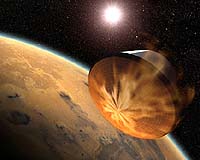
Huntsville AL (SPX) Dec 21, 2006 Tapping the power of 1,500 suns, scientists at NASA's Marshall Space Flight Center have met a critical milestone in the development of aerocapture technology, a maneuver that primarily uses a planet's atmosphere to capture a spacecraft and place it in the desired orbit. The In-Space Propulsion Technology Project at NASA's Marshall Space Flight Center in Huntsville, Ala., has successfully tested a series of 12-inch-square thermal protection panels. The tests focused on a type of spacecraft shielding material called an advanced charring ablator. "The tests exposed ablators to solar power levels up to 150 watts per square centimeter -- approximately 1,500 times the intensity of the sun on Earth on a clear day," said Bonnie James, aerocapture technology manager at the Marshall Center. "This helped us simulate the high temperatures encountered by a space vehicle using aerocapture to complete a hypersonic flight through a planet's atmosphere." The tests were part of a larger effort by NASA and technology developers from partnering institutions to place space vehicles into long-duration orbits around distant planets and other bodies throughout the solar system without heavy, on-board fuel loads. Instead, the nearly propellant-less method uses friction to slow a spacecraft entering the atmosphere of its destination planet. The thermal protection system shields the spacecraft from heat produced by the friction. The tests were conducted at the Sandia National Laboratories in Albuquerque, N.M. Located on Kirtland Air Force base, Sandia's National Solar Thermal Test Facility is a nine-acre test site with a 200-foot-tall solar tower, 212 computer-controlled mirrors called heliostats and a separate five-story control tower. The heliostats harness the power of the sun and direct it to a test sample mounted on top of the solar tower. With the total mirror area exceeding 84,000 square feet, the facility can subject specimens to up to 260 watts of thermal energy per square centimeter -- about 2,600 times the intensity of the sun on Earth. "Data from the tests are helping us determine the overall suitability of advanced thermal protection systems, adhesives and structure combinations for a future rigid aeroshell system," said James. Aeroshells are protective "shells" that surround the spacecraft. The aeroshell and thermal protection systems under study have similar characteristics to those developed for past missions to Venus, Mars and Jupiter, along with missions to return spacecraft from the moon to Earth. During the last three years, NASA and its partnering organizations have conducted more than 100 similar tests on samples ranging from 5-inch-diameter heat shield components to panels up to 24 inches square. The tests also advance the technology readiness level of ablator families funded by the In-Space Propulsion Technology Program. With lower densities, higher performance and better insulative properties than current state-of-the-art technologies, these ablators have the potential to round out NASA's current thermal protection system portfolio for aerocapture and planetary entry. Aerocapture technology development is funded by NASA's In-Space Propulsion Technology Program. Community Email This Article Comment On This Article Related Links NASA Marshall Space Flight Center Rocket Science News at Space-Travel.Com Rocket Science News at Space-Travel.Com
 Rocketplane Kistler's K-1 Aerospace Vehicle Takes-Off With UGS PLM Technology
 Plano TX (SPX) Dec 21, 2006
UGS has announced Rocketplane Kistler selected NX(R) software, UGS digital product development solution, to design, build and test its Kistler K-1 aerospace vehicle. The K-1, a fully reusable, two stage orbital launch vehicle, is a low-cost and reliable vehicle capable of delivering a variety of payloads to a wide range of altitudes and inclinations in Low Earth Orbit (LEO). |
|
|

| The content herein, unless otherwise known to be public domain, are Copyright 1995-2006 - SpaceDaily.AFP and UPI Wire Stories are copyright Agence France-Presse and United Press International. ESA PortalReports are copyright European Space Agency. All NASA sourced material is public domain. Additionalcopyrights may apply in whole or part to other bona fide parties. Advertising does not imply endorsement,agreement or approval of any opinions, statements or information provided by SpaceDaily on any Web page published or hosted by SpaceDaily. Privacy Statement |