|
 |
 |
 |
 |
 |
 |
 |
 |

 |
NASA Marks Five Years Of A Unique Room With A View
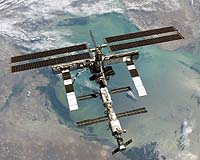
Houston TX (SPX) Nov 02, 2005 Break out the thermostabalized beef tips with mushrooms and rehydratable apple cider! Tomorrow, NASA and the international space station partners celebrate a major milestone, as the unique orbiting laboratory marks the fifth anniversary of continuous, onboard human presence. As of tomorrow, crews have lived and worked on the station more than 1,826 consecutive days. "This milestone for the station is really only the first leg in a much longer journey," said Bill Gerstenmaier, NASA's associate administrator for space operations. "The experiences we're having on station with crews on long-duration missions are teaching us what it will take to send astronauts on longer missions to the moon and into the solar system." The station is an important step in international space exploration; 16 countries joined together on the largest, most complex peacetime multinational space program in history. Since the first crew arrived Nov. 2, 2000, the station has grown from a room with a fantastic view into an unparalleled, state-of-the-art laboratory complex. "International space station was built by tens of thousands of individuals in the U.S. and in partner nations, in an era when many said it could not be done," said Bill Shepherd. He was the commander of Expedition 1, the first crew to live on the station. "The shape of our future space exploration is still to be formed. We may have adequate technologies, but exploration is more about purpose. We are at a crossroads, deciding whether we are bound to inhabit only the Earth, or if humans are to live and work far from the home planet. Station is a start to this journey. Let us continue with new explorations which are more expansive and bold; voyages which will define us as a space faring civilization," Shepherd said. The station's 12th resident crew, Commander William McArthur and Flight Engineer Valery Tokarev, began a six-month stay aboard the complex Oct. 3. Since the first crew's arrival, the station's internal volume has increased from the size of an efficiency apartment to a conventional three-bedroom house. "What NASA and our international partners are learning by building and operating the space station will directly benefit future exploration," said International Space Station Program Manager Michael Suffredini. The station has a unique microgravity environment that cannot be duplicated on Earth, and it provides a home with 15,000 cubic feet of habitable space. It has living quarters, a galley and a weightless "weight room," where astronauts do aerobic and resistance exercises. Critical issues in human health must be resolved before humans go on missions to Mars. Scientific investigations ranging from basic science to exploration research have been done on the station. Many of these experiments will answer key questions that will help shape spacecraft and life-support design decisions for future exploration. NASA scientists have made great strides understanding the significant rate of bone loss by crews while in orbit and determining where that loss is occurring; vital information for long-duration missions. Because cosmic radiation is a major risk factor in human space missions, NASA scientists have used the station to test techniques to characterize the environment and generate computer models for shielding. Crews have trained on and experimented with medical ultrasound equipment as a research and diagnostic tool. They use a telemedicine strategy that could have widespread applications in emergency and rural care situations on Earth. Crews have used in-space soldering to test hardware repair techniques, providing a better understanding of fabrication and repair methods astronauts may need on long flights. Station crews have taken more than 177,000 images of Earth, providing scientists with information pertinent to scientific disciplines from climatology to geology. There have been 97 visitors onboard the station from 10 countries in the past five years. Twenty-nine have lived aboard as members of the 12 station expedition crews. Russian cosmonaut Sergei Krikalev is the only one to serve as a member of two resident crews, Expedition 1 in November 2000 and Expedition 11 this year. The station partnership includes NASA, the Russian Federal Space Agency, the Canadian Space Agency, the European Space Agency and the Japan Aerospace Exploration Agency.
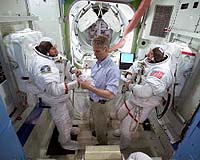
Station Spacewalk to Install New Cameras, Jettison FPP Houston TX (SPX) Nov 02 - It will be on with the new and off with the old during the first station-based spacewalk in U.S. suits in more than two years. Members of the 12th station crew, Commander and NASA Science Officer Bill McArthur and Flight Engineer Valery Tokarev, are scheduled to install a new camera assembly during the Nov. 7 spacewalk, beginning about 9:30 a.m. EST. They also will remove and jettison the Floating Potential Probe.

|