|
 |
 |
 |
 |
 |
 |
 |
 |

 |
NASA Marks 30th Anniversary Of Mars Viking Mission
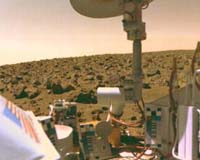
Pasadena CA (SPX) Jul 20, 2006 Thirty years after the first successful landing on Mars by NASA's Viking spacecraft, the ambitious mission continues to evoke pride and enthusiasm for future space exploration. NASA's Viking 1 and 2 missions to Mars, each consisting of an orbiter and a lander, became the first space probes to obtain high resolution images of the Martian surface; characterize the structure and composition of the atmosphere and surface; and conduct on-the-spot biological tests for life on another planet. Viking 1 was launched Aug. 20, 1975, and arrived at Mars on June 19, 1976. On July 20, 1976, the Viking 1 lander separated from the orbiter and touched down at Chryse Planitia. Viking 2 was launched Sept. 9, 1975, and entered Mars orbit Aug. 7, 1976. The Viking 2 lander touched down at Utopia Planitia on Sept. 3, 1976. "The Viking team didn't know the Martian atmosphere very well, we had almost no idea about the terrain or the rocks, and yet we had the temerity to try to soft land on the surface," recalled Gentry Lee, Solar System Exploration chief engineer at NASA's Jet Propulsion Laboratory. Lee was the science analysis and mission planning director for the Viking mission. "We were both terrified and exhilarated. All of us exploded with joy and pride when we saw that we had indeed landed safely." "The Viking mission looms like a legendary giant, an incredible success against which all present and future missions will be measured," said Doug McCuiston, Mars Exploration Program director at NASA headquarters in Washington, D.C. Originally designed to function for 90 days, the Viking spacecraft continued collecting data for more than six years. The landers accumulated 4,500 up-close images of the Martian surface. The accompanying orbiters provided more than 50,000 images, mapping 97 percent of the planet. Viking provided the first measurements of the atmosphere and surface of Mars. These measurements are still being analyzed and interpreted. The data suggested early Mars was very different from the present day planet. Viking performed the first successful entry, descent and landing on Mars. Derivations of a Viking-style thermal-protection system and parachute have been used on every U.S. Mars lander mission, including Mars Pathfinder and the Mars Exploration Rovers, Spirit and Opportunity. NASA's Langley Research Center in Hampton, Va., managed the Viking Program. JPL, managed by the California Institute of Technology, built the orbiters, provided the deep space network and managed the science mission. Glenn Research Center in Cleveland, Ohio, designed the Titan/Centaur launch vehicles that propelled the spacecraft on their journey. Kennedy Space Center in Florida provided the launch facility for the program, and scientists from across NASA served on the Viking science teams. Community Email This Article Comment On This Article Related Links Viking information NASA Mars News and Information at MarsDaily.com Lunar Dreams and more
 Mars Expeditions Pose Bone-Loss Risk
 Cape Canaveral FL (SPX) Jul 20, 2006
Astronauts who travel in space are at risk for bone loss in much the same way as cancer patients who receive radiation therapy, and both groups are more likely to develop fractures than the general population. |
|
|

| The content herein, unless otherwise known to be public domain, are Copyright 1995-2006 - SpaceDaily.AFP and UPI Wire Stories are copyright Agence France-Presse and United Press International. ESA PortalReports are copyright European Space Agency. All NASA sourced material is public domain. Additionalcopyrights may apply in whole or part to other bona fide parties. Advertising does not imply endorsement,agreement or approval of any opinions, statements or information provided by SpaceDaily on any Web page published or hosted by SpaceDaily. Privacy Statement |