
 |
 |
 |
 |
 |
 |
 |
 |
 |

 |
NASA Hearing Daily From Weak Phoenix Mars Lander
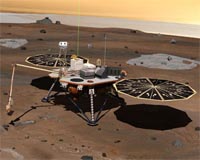
Pasadena CA (SPX) Nov 05, 2008 NASA's Phoenix Mars Lander has communicated with controllers daily since Oct. 30 through relays to Mars orbiters. Information received over the weekend indicates Phoenix is running out of power each afternoon or evening but reawakening after its solar arrays catch morning sunlight. The fraction of each day with sun above the horizon is declining at the Martian arctic landing site. Dust raised by a storm last week continues to block some of the sunshine. "This is exactly the scenario we expected for the mission's final phase, though the dust storm brought it a couple weeks sooner than we had hoped," said Phoenix Project Manager Barry Goldstein of NASA's Jet Propulsion Laboratory, Pasadena, Calif. "We will be trying to gain some additional science during however many days we have left. Any day could be our last." Mission engineers at JPL and at Lockheed Martin Space Systems, Denver, are attempting this week to upload commands to be stored in the lander's flash memory for science activities to be conducted when the lander wakes up each day. "Weather observations are our top priority now," said Phoenix Principal Investigator Peter Smith. "If there's enough energy, we will try to get readings from the conductivity probe that has been inserted into the soil, and possibly some images to assess frost buildup." Phoenix landed on Mars May 25. It accomplished its main science goals during the three months originally planned as its prime mission, then continued operating, now in its sixth month. Community Email This Article Comment On This Article Share This Article With Planet Earth
Related Links Phoenix at LPL Phoenix at NASA Mars News and Information at MarsDaily.com Lunar Dreams and more
 NASA: Phoenix weak and getting weaker
 Pasadena, Calif. (UPI) Nov 4, 2008
 The U.S. space agency says its Phoenix Mars Lander has communicated with controllers daily since Sunday, but it is becoming weaker. |
|
|

| The content herein, unless otherwise known to be public domain, are Copyright 1995-2007 - SpaceDaily.AFP and UPI Wire Stories are copyright Agence France-Presse and United Press International. ESA Portal Reports are copyright European Space Agency. All NASA sourced material is public domain. Additional copyrights may apply in whole or part to other bona fide parties. Advertising does not imply endorsement,agreement or approval of any opinions, statements or information provided by SpaceDaily on any Web page published or hosted by SpaceDaily. Privacy Statement |
 del.icio.us
 Digg
Digg Reddit
 YahooMyWeb
 Google
 Facebook