|
 |
 |
 |
 |
 |
 |
 |
 |

 |
NASA Gives Green Light For SOFIA
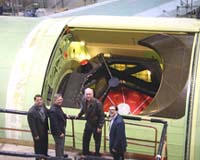
Columbia MD (SPX) Jul 24, 2006 A major project of NASA and the German aerospace agency DLR to build an airborne astronomical observatory has received the go-ahead to complete the nearly finished effort. Meanwhile the project continues to pass crucial milestones in its development. Called the Stratospheric Observatory for Infrared Astronomy, or SOFIA, the NASA/DLR mission uses a heavily modified Boeing 747-SP aircraft to carry aloft a telescope larger than the Hubble Space Telescope. The aircraft, which has a large opening for the telescope in its left flank, will fly to altitudes of up to 45,000 feet, putting it above more than 99 percent of Earth's obscuring water vapor. SOFIA represents one of the largest modifications ever undertaken to a Boeing 747 aircraft. A large section of the rear of the 747 is essentially newly built, with a large cavity and pressurized bulkhead to accommodate the telescope and its intricate door and aperture system. The door will open in flight to allow astronomical observations. NASA had held off on committing final funding to the project in its fiscal year 2007 budget submission to Congress, pending the outcome of a special review of the project by a panel of outside experts. On June 15, following its review, NASA announced the conclusion that "there were no insurmountable technical or programmatic challenges to the continued development of (SOFIA)." On July 6, addressing the NASA Advisory Council Science Subcommittees, Michael Griffin, the agency's administrator, said, "Having received this report, I now believe the best course going forward is to continue SOFIA ... I have made this consideration carefully, and I believe that it is the best course of action for SOFIA as well as the rest of the astronomy and astrophysics portfolio." Last month, the aircraft, with the telescope inside, received a rigorous "Ground Vibration Test" at the L-3 Communications Integrated Systems facility in Waco, Texas. The test involved installing sensors throughout SOFIA and then shaking the aircraft for many hours per day during a 10-day span. At times, the shaking was enough to make the wings visibly flap up and down in the hangar, by distances of a foot or more. During some parts of the test, the telescope was held stationary; during other parts, the telescope was moved slowly as it would during scientific research observations. Preliminary analysis of the test data showed no problems or surprises. SOFIA is being prepared for its first test flight later this year. Having passed the vibration test, the airborne observatory is now scheduled for a series of aircraft ground operational tests and finishing touches. In July and August, the aircraft will undergo fueling and pressure tests, culminating in run-ups of the newly installed engines. A joint endeavor between NASA and the DLR, SOFIA will be a major international scientific facility once it is operational. For its part, Germany contributed the 2.5-meter telescope, which is considered a marvel of engineering, and will continue to contribute twenty percent to the future operation of the flying observatory. Future scientific operation of SOFIA will be carried out by the Universities Space Research Association, in Columbia, Md., under funding from NASA, and by the German SOFIA Institute, located at the University of Stuttgart, under funding from the DLR. SOFIA will provide an excellent platform for the study of black hole environments, galactic evolution, the chemical composition of interstellar gas clouds, complex organic molecules in space, and the formation of stars and solar systems. SOFIA will also provide a unique opportunity for educators to partner with scientists on research missions. "The findings of the panel that reviewed the SOFIA project did not surprise those of us who have been close to the project," said David Black, president of USRA. "I was pleased to hear of Administrator Griffin's decision, and we look forward to moving ahead as expeditiously as possible to bring this remarkable observatory to operation." "This is fantastic news and a great boost to infrared and sub-millimeter astrophysics," said Eric Becklin, SOFIA's chief scientist. Hans-Peter Roeser, leader of the DSI, said he assumes SOFIA will fly as early as this year. "As the last FAA-required structural test before flight, our L-3 team is proud of its role in taking this observatory from design to reality," said Ed Gloviak, L-3 Integrated Systems vice president for special programs and services. Community Email This Article Comment On This Article Related Links SOFIA at Universities Space Research Association Space Telescope News and Technology at Skynightly.com
 First Data Release From UKIRT Infrared Deep Sky Survey
 Swindon, England (SPX) Jul 21, 2006
British astronomers announced Thursday they are releasing the first data from the largest and most sensitive survey of the heavens in infrared light to scientists across Europe. |
|
|

| The content herein, unless otherwise known to be public domain, are Copyright 1995-2006 - SpaceDaily.AFP and UPI Wire Stories are copyright Agence France-Presse and United Press International. ESA PortalReports are copyright European Space Agency. All NASA sourced material is public domain. Additionalcopyrights may apply in whole or part to other bona fide parties. Advertising does not imply endorsement,agreement or approval of any opinions, statements or information provided by SpaceDaily on any Web page published or hosted by SpaceDaily. Privacy Statement |