|
 |
 |
 |
 |
 |
 |
 |
 |

 |
NASA Gives Artificial Gravity A New Spin
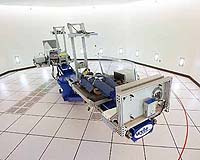
Galveston TX (SPX) May 2, 2005 NASA will use a new human centrifuge to explore artificial gravity as a way to counter the physiologic effects of extended weightlessness for future space exploration. The new research will begin this summer at the University of Texas Medical Branch (UTMB) at Galveston, overseen by NASA's Johnson Space Center (JSC) in Houston. A NASA-provided Short-Radius Centrifuge will attempt to protect normal human test subjects from deconditioning when confined to strict bed rest. Bed rest can closely imitate some of the detrimental effects of weightlessness on the body. For the first time, researchers will systematically study how artificial gravity may serve as a countermeasure to prolonged simulated weightlessness. "The Vision for Space Exploration includes destinations beyond the moon," said Dr. Jeffrey Davis, director of JSC's Space Life Sciences Directorate. "This artificial gravity research is an important step in determining if spacecraft design options should include artificial gravity. The collaboration between NASA, the National Institutes of Health (NIH), UTMB and Wyle Laboratories demonstrates the synergy of government, academic and industry partnerships," he added. For the initial study this summer, 32 test subjects will be placed in a six-degree, head-down, bed-rest position for 21 days to simulate the effects of microgravity on the body. Half that group will spin once a day on the centrifuge to determine how much protection it provides from the bed-rest deconditioning. The "treatment" subjects will be positioned supine in the centrifuge and spun up to a force equal to 2.5 times Earth's gravity at their feet for an hour and then go back to bed. "The studies may help us to develop appropriate prescriptions for using a centrifuge to protect crews and to understand the side effects of artificial gravity on people," said Dr. Bill Paloski, NASA principal scientist in JSC's Human Adaptation and Countermeasures Office and principal investigator for the project. "In the past, we have only been able to examine bits and pieces. We've looked at how artificial gravity might be used as a countermeasure for, say, cardiovascular changes or balance disorders. This will allow us to look at the effect of artificial gravity as a countermeasure for the entire body," he added. The research will take place in UTMB's NIH-sponsored General Clinical Research Center. The study supports NASA's Artificial Gravity Biomedical Research Project. "Physicians and scientists from all over the world will travel to UTMB to study the stresses that spaceflight imposes on cardiovascular function, bone density, neurological activity and other physiological systems," said Dr. Adrian Perachio, executive director of strategic research collaborations at UTMB. "This is an excellent example of collaboration among the academic, federal and private sectors in research that will benefit the health of both astronauts and those of us on Earth," he added. The centrifuge was built to NASA specifications by Wyle Laboratories in El Segundo, Calif. It was delivered to UTMB in August 2004 and will complete design verification testing, validation of operational procedures and verification of science data this spring. The centrifuge has two arms with a radius of 10 feet (3 meters) each. The centrifuge can accommodate one subject on each arm. Paloski has assembled a team of 24 investigators who designed the study. The first integrated research program is expected to end in the fall of 2006. Community Email This Article Comment On This Article Related Links SpaceDaily Search SpaceDaily Subscribe To SpaceDaily Express Space Technology News - Applications and Research
 Industry Team Achieve New Communications Technology With AESA Radars
 Baltimore MD (SPX) Jan 12, 2006
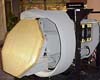
A team comprised of three leading US aerospace and defense contractors has demonstrated an innovative technological use of active electronically scanned array (AESA) radars for high-bandwidth communications. |
|
|

| The content herein, unless otherwise known to be public domain, are Copyright 1995-2006 - SpaceDaily.AFP and UPI Wire Stories are copyright Agence France-Presse and United Press International. ESA PortalReports are copyright European Space Agency. All NASA sourced material is public domain. Additionalcopyrights may apply in whole or part to other bona fide parties. Advertising does not imply endorsement,agreement or approval of any opinions, statements or information provided by SpaceDaily on any Web page published or hosted by SpaceDaily. Privacy Statement |