|
 |
 |
 |
 |
 |
 |
 |
 |

 |
NASA Genesis Spacecraft On Final Lap Toward Home
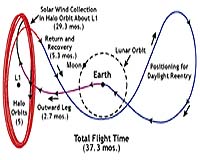
Pasadena CA (SPX) May 06, 2004 NASA's Genesis spacecraft flew past Earth on Saturday in a loop that puts it on track for home � and a dramatic mid-air recovery Sept. 8. The Genesis mission was launched in August of 2001 to capture samples from the storehouse of 99-percent of all the material in our solar system � the Sun. The samples of solar wind particles, collected on ultra-pure wafers of gold, sapphire, silicon and diamond, will be returned for analysis by Earth- bound scientists. The samples Genesis will provide will supply scientists with vital information on the composition of the Sun, and will shed light on the origins of our solar system. "Genesis has been way out there collecting samples from space for a long time," said Genesis project manager Don Sweetnam of NASA's Jet Propulsion Laboratory, Pasadena, Calif. "Saturday, we brushed past Earth just beyond the Moon's orbit. "On September 6, we will again approach Earth at lunar distance, but this time we are going to come on in carrying NASA's first samples from space since Apollo 17 carried the last moon rocks back in December of 1972." The Earth flyby occurred at about 3:00 a.m. Pacific Daylight Time on Saturday, May 1, at an altitude of 386,000 kilometers (239,850 miles) above the planet's surface � just beyond the Moon's orbit. At that time, the spacecraft was traveling at a speed relative to Earth of 1.26 kilometers per second (2,800 miles per hour). Helicopter flight crews, navigators and mission engineers are preparing for the return of the spacecraft. The will dispatch a sample return capsule that will re-enter Earth's atmosphere for a planned mid-air capture at the U.S. Air Force Utah Test and Training Range on Sept. 8. To preserve the delicate particles of the Sun, specially trained helicopter pilots will snag the return capsule from mid-air using custom-designed hooks. The flight crews for the two helicopters assigned for Genesis capture and return are comprised of former military aviators and Hollywood stunt pilots. Community Email This Article Comment On This Article Related Links Genesis Capture And Return SpaceDaily Search SpaceDaily Subscribe To SpaceDaily Express Life Beyond Earth Lands Beyond Beyond - extra solar planets - news and science
 Latching Onto Lichen
 Moffett Field CA (SPX) Dec 06, 2005
Bacteria can often survive the harsh conditions of space, and their toughness and adaptability have made them key candidates for the transfer of life between planets. But in a recent study by European scientists, lichen survived a trip in space even better than bacteria do. |
|
|

| The content herein, unless otherwise known to be public domain, are Copyright 1995-2006 - SpaceDaily.AFP and UPI Wire Stories are copyright Agence France-Presse and United Press International. ESA PortalReports are copyright European Space Agency. All NASA sourced material is public domain. Additionalcopyrights may apply in whole or part to other bona fide parties. Advertising does not imply endorsement,agreement or approval of any opinions, statements or information provided by SpaceDaily on any Web page published or hosted by SpaceDaily. Privacy Statement |