|
 |
 |
 |
 |
 |
 |
 |
 |

 |
NASA Finds Evidence For New Molecular Structure In Space
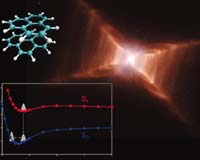
Moffett Field CA (SPX) Apr 09, 2007 NASA scientists have discovered evidence that a mysterious red glow, seen throughout the Milky Way and other galaxies but never on Earth, radiates from extremely fine dust clusters that cause the glow by combining molecular forces that oppose each other. Researchers theorize that the red glow, called the Extended Red Emission (ERE), is due to a very unusual form of charged molecular clusters. Measured in billionths of a meter (billionths of a yard), these tiny clusters are made of carbon-rich molecules called polycyclic aromatic hydrocarbons (PAHs) that are chicken-wire shaped. Astronomers have been unable to explain the red glow for more than 30 years, even though PAHs were implicated. The highly luminescent source material requires very harsh ultraviolet radiation, a radiation field so strong that most known polyatomic interstellar molecules would be destroyed. NASA Ames Research Center has been a leader in the study of PAHs under the direction of Ames Astrochemistry Laboratory led by Dr. Louis Allamandola. We have been studying polycyclic aromatic hydrocarbon molecules (PAHs) in the laboratory at NASA Ames Research Center for a long time, and although I had results that strongly supported the idea that PAHs had something to do with the ERE, the experimental results made it clear that if PAHs were involved, they were present in some as-yet unknown exotic form," said Murthy Gudipati of the University of Maryland and NASA Ames, who recently joined NASAs Jet Propulsion Laboratory after many years of close collaboration with Allamandola. "These types of highly reactive species are simply not readily accessible for laboratory study, but need very special conditions, added Gudipati. Through a combined effort of laboratory and theoretical chemistry calculations, the current advance in knowledge was made. Using advanced computational methods, scientists found that the red glow is indeed carried by unusual clusters of polycyclic aromatic hydrocarbon molecules. Highly developed tests confirm the presence of opposing properties within each cluster; they are charged and highly reactive, yet simultaneously, they have a stable, closed-shell electron configuration as does any stable molecule on Earth. Recent advances in theoretical techniques made it possible to tackle this problem computationally. Significant difficulties involved in the modeling of charge transfer within large molecular systems required an entirely new approach, said Dr. Timothy Lee, astrochemist and chief of the Space Science and Astrobiology Division at NASA Ames. "Once we convinced ourselves that our new approach could handle these strange particles, I was able to simulate the detailed emission process on molecular systems much larger than any that had been done before," said Young Min Rhee, postdoctoral fellow at the University of California, Berkeley, and the lead author of the paper published last month in the Proceedings of the National Academy of Sciences. "Our simulation shows that this type of charged PAH cluster can account for the ERE while satisfying the physical requirements necessary to survive the harsh interstellar conditions continued Rhee. According to scientists, this research has important implications in other areas as well, including combustion processes and exotic nano-materials. For instance, the formation of soot particles produced by diesel and jet engine combustion is not well understood. Self-forming PAH clusters may be the key step to understanding this process. Evidence suggests there is closed-shell charged PAH ions in flames, and the highly robust yet unusual closed-shell PAH clusters described here may be the soot nucleation sites in flames, a result that has been long anticipated. Authors: Y.M. Rhee (University of California, Berkeley); T.J. Lee (NASA Ames Research Center); M.S. Gudipati (Jet Propulsion Laboratory); L.J. Allamandola (NASA Ames Research Center); M. Head-Gordon (University of California, Berkeley) Community Email This Article Comment On This Article Related Links More science at PNAS Redglow at NASA Ames Stellar Chemistry, The Universe And All Within It Stellar Chemistry, The Universe And All Within It
 X-ray Satellites Catch Magnetar In Gigantic Stellar Hiccup
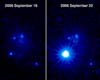 London, UK (SPX) Apr 09, 2007
Astronomers using data from several X-ray satellites have caught a magnetar - the remnant of a massive star with an incredibly strong magnetic field - in a sort of giant cosmic blench. |
|
|

| The content herein, unless otherwise known to be public domain, are Copyright 1995-2006 - SpaceDaily.AFP and UPI Wire Stories are copyright Agence France-Presse and United Press International. ESA PortalReports are copyright European Space Agency. All NASA sourced material is public domain. Additionalcopyrights may apply in whole or part to other bona fide parties. Advertising does not imply endorsement,agreement or approval of any opinions, statements or information provided by SpaceDaily on any Web page published or hosted by SpaceDaily. Privacy Statement |